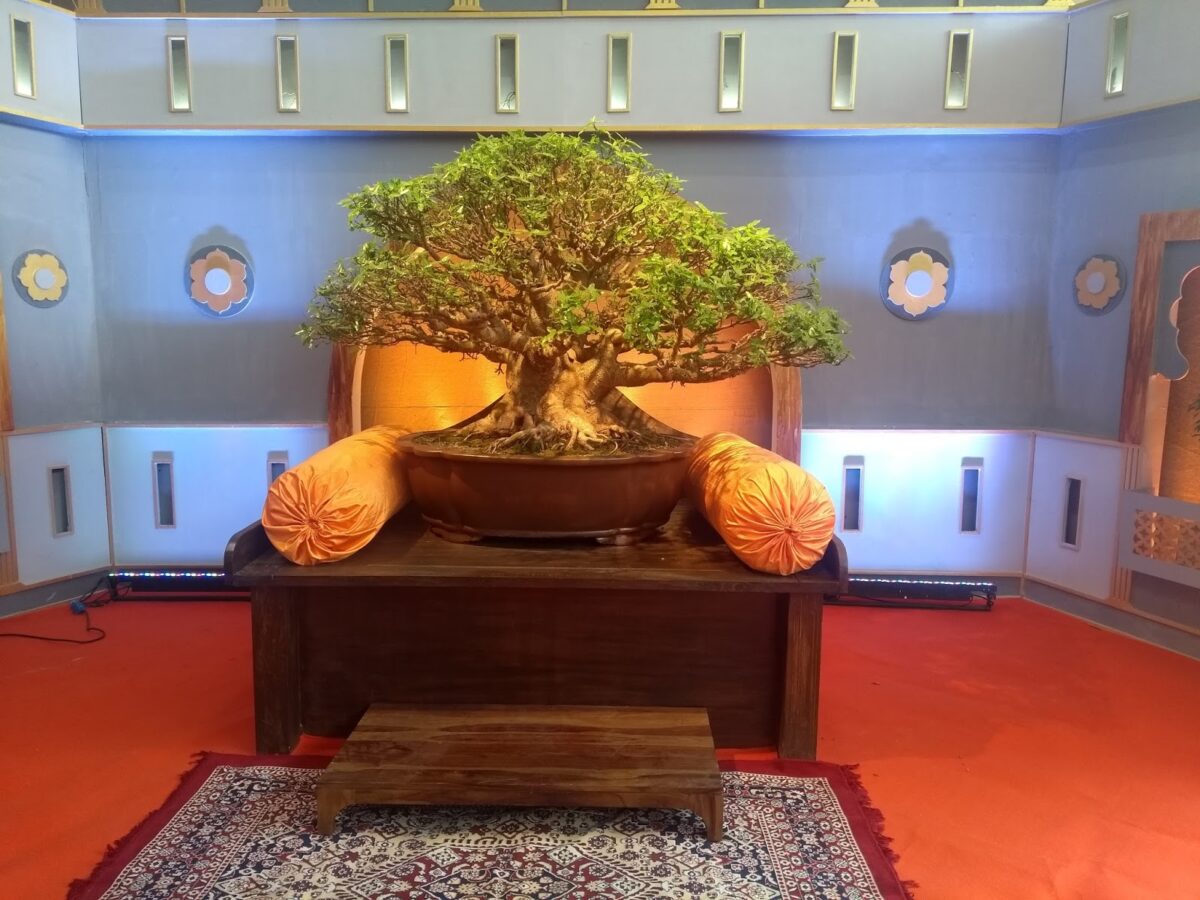
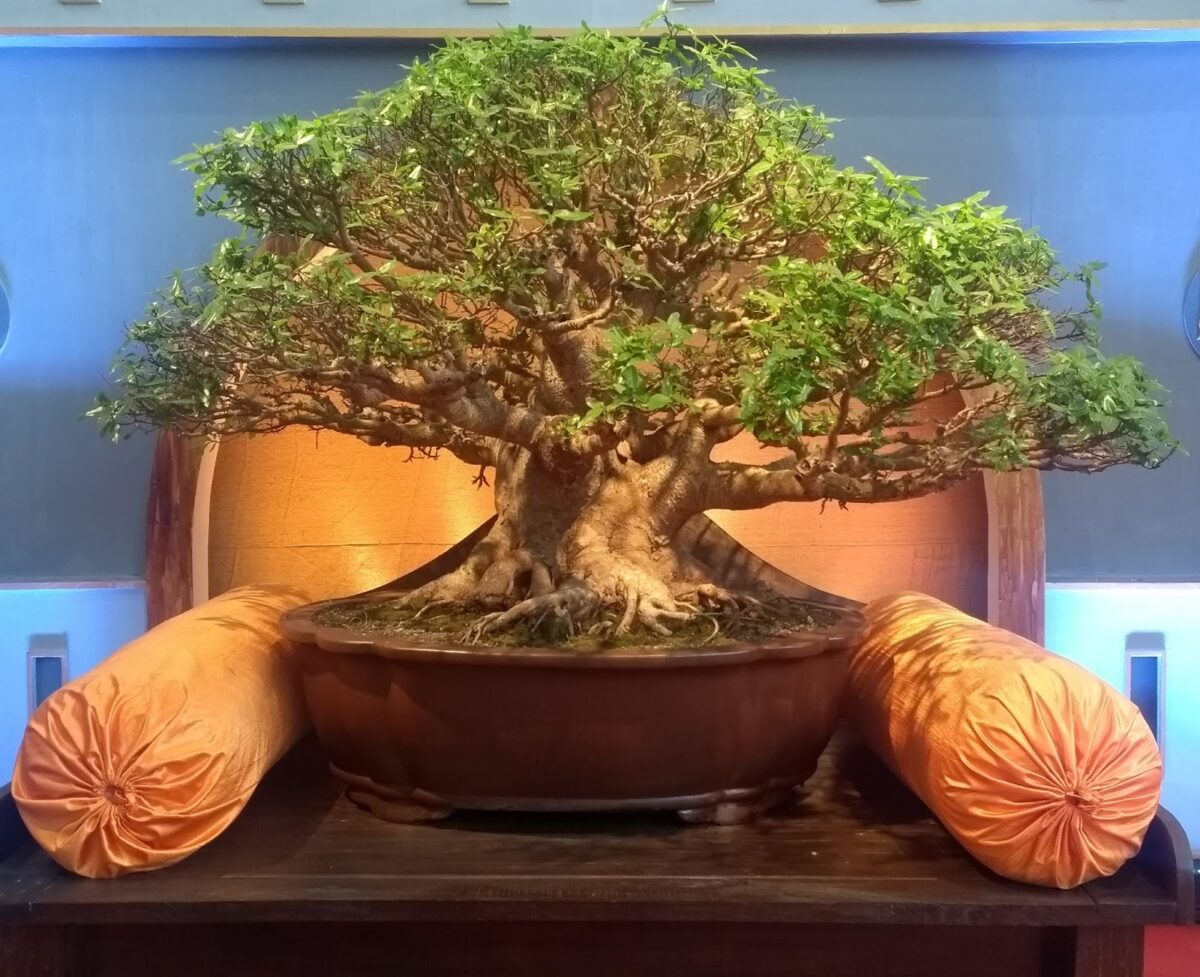
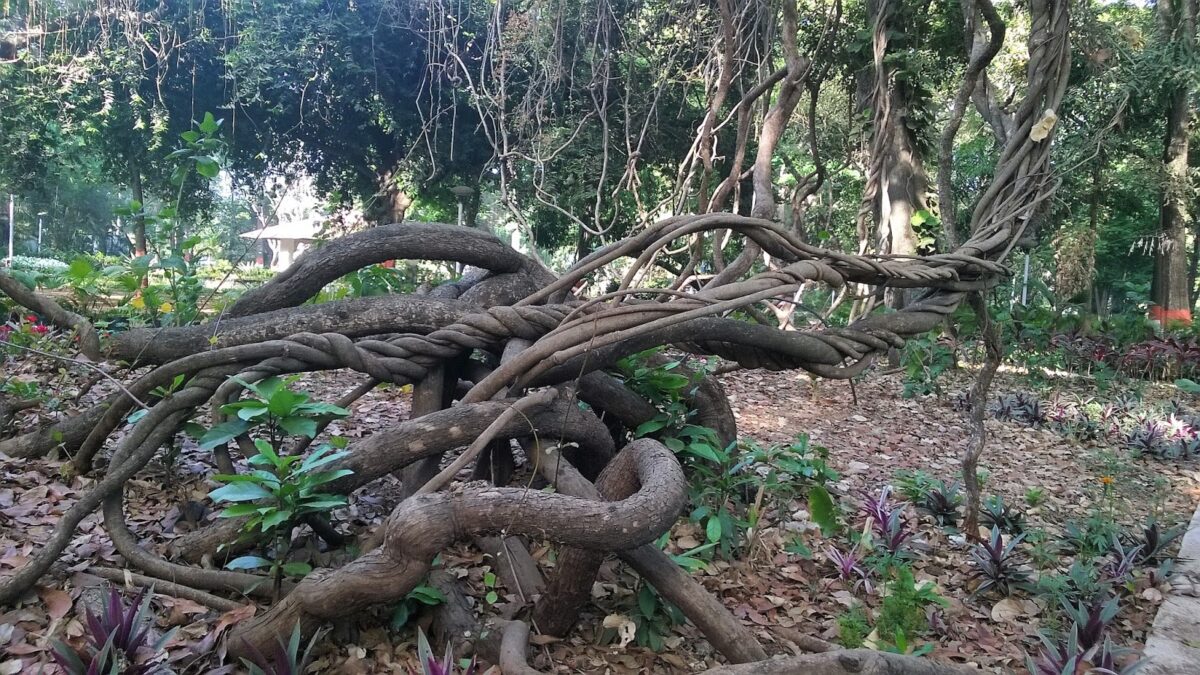
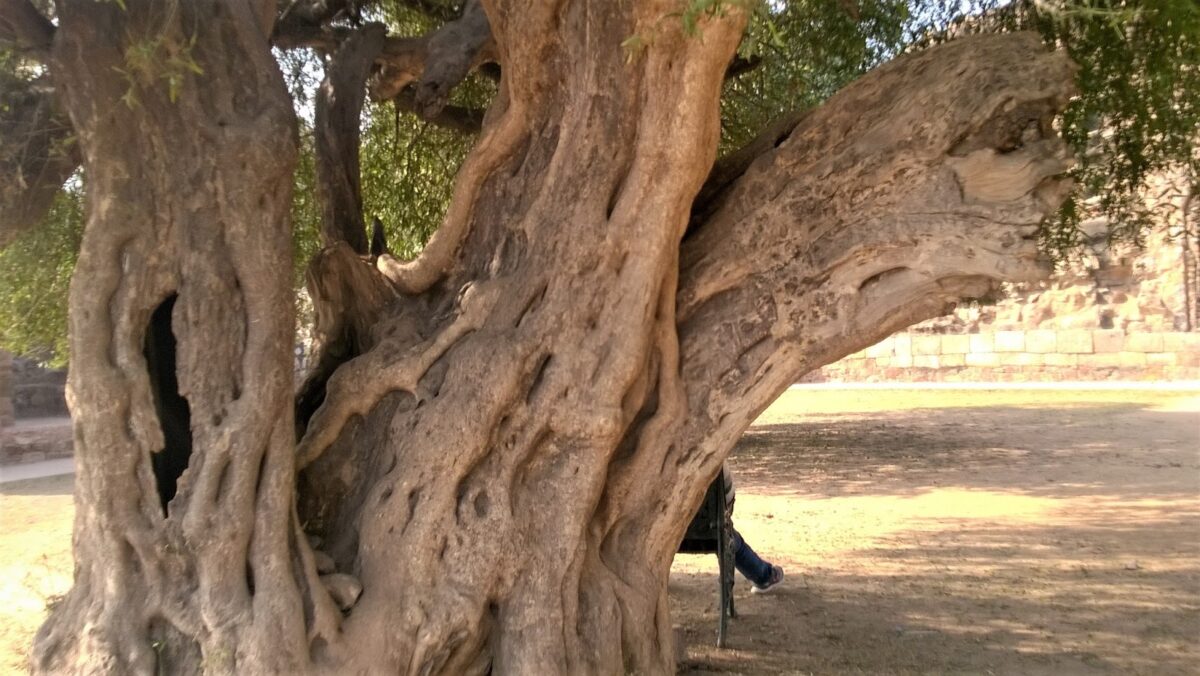
This is a very old and massive Ficus tree that I saw at the recent Bonsai Namaste exhibition in Pune (age was upto 150 years according to the organisers). In keeping with its status, the tree was accorded a royal status and displayed in this unique manner…
A King among the other wonderful Bonsai trees…
Here is a closer look….
Amazing isn’t it?
I am participating in Parul’s #ThursdayTreeLove36. Do head over to see some amazing trees from around the world.
Our trip to Sundarbans was booked so long in advance that we managed to log three more destinations in the intervening period! There was no scope for travel fatigue as Amitav Ghosh’s The Hungry Tide kept interest levels high and if possible even increased them. Yet there was an underlying element of doubt as the area is the home of the swimming tigers.. the Royal Bengal Tiger.
Nurturing these doubts would serve no purpose if I was to enjoy my holiday so I buried them as much as I could as we embarked on the journey in the wee hours of the D-Day. From Kolkata city we travelled to Godkhali – the place where we were to board our boat. The young bus driver treated this drive like a Formula 1 training session, overtaking everything and everyone in sight. This meant close encounters with cattle, villagers and other vehicles irrespective of their direction of motion. The road was infested with buses and rickety three wheeled vehicles that had passengers stuffed inside, hanging outside and even on top! With our destination only 10 kms away, Murphy made his presence felt in the form of a burst tyre. The aforesaid young man showed equal speed and proved his mettle by making quick work of replacing the troublesome auto component – faster than our group leader could summon the rickshaws to take us the final few kilometers…
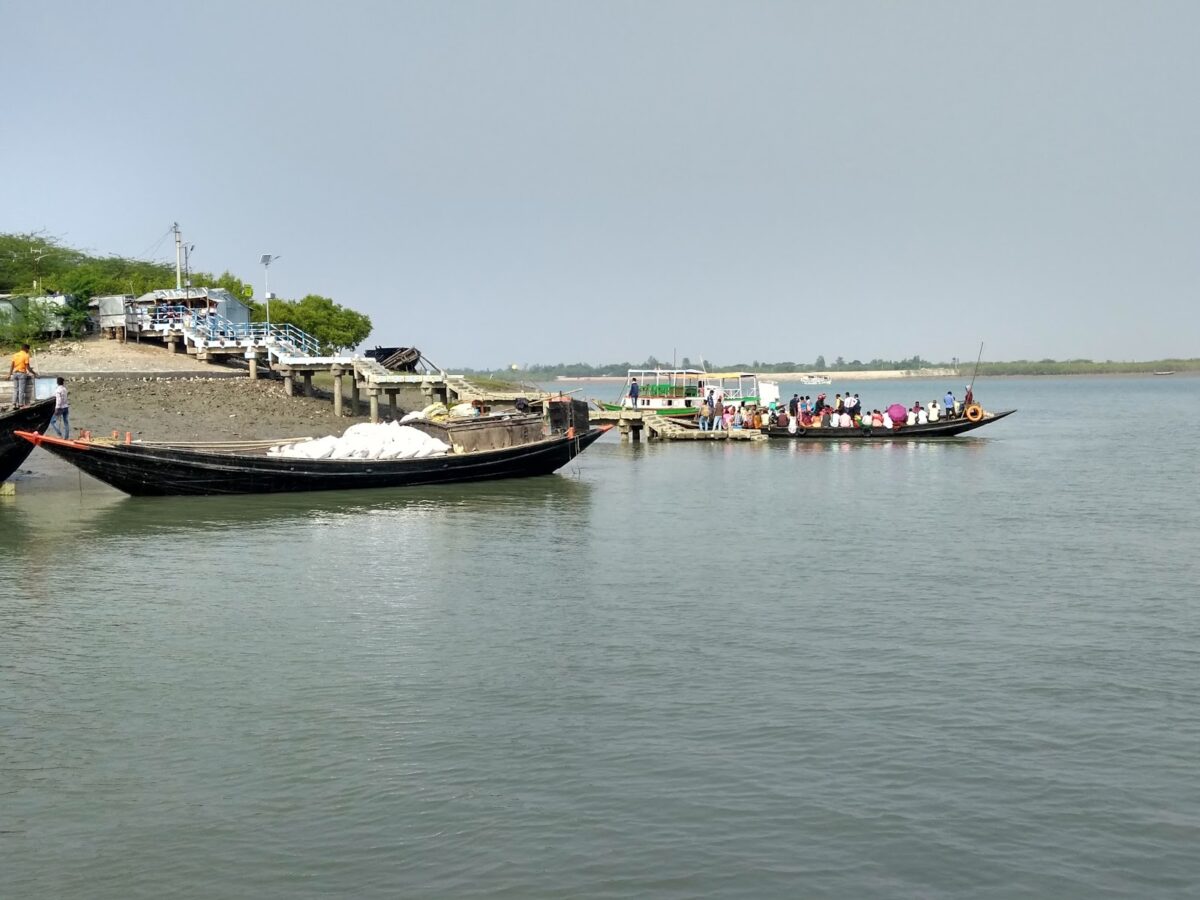
The jetty at Godkhali is rather unassuming considering that it is the main sourcing point for the islands in the Sundarbans delta. After a quick settling in at our resort we took off for our first glimpse of the jungle.
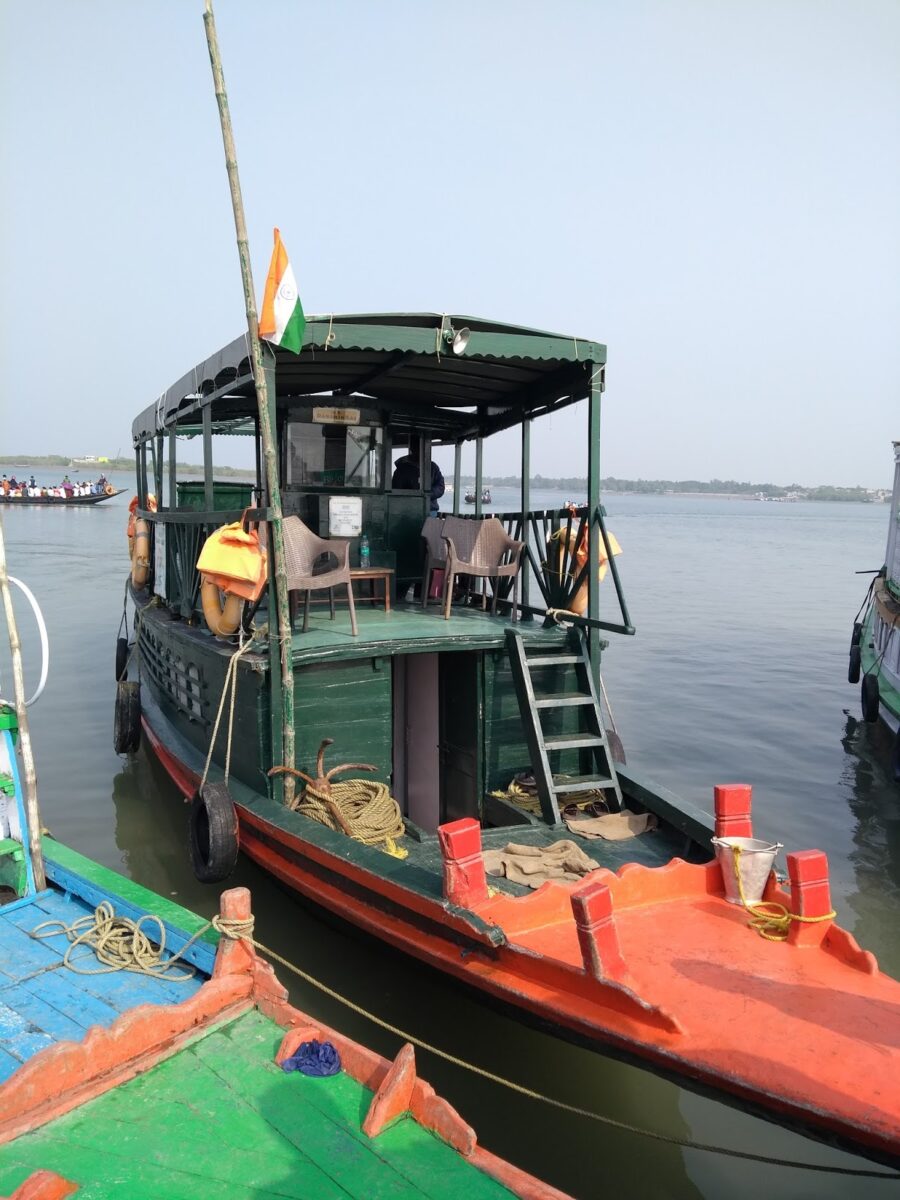
Our boat which was to be our home for the next 3 days boasted of a kitchen and toilet (I give it 4 stars considering its location) with sufficient space for everyone in our group to get a ring side view of the forest without stepping on each others toes!
ALERT: LONG POST
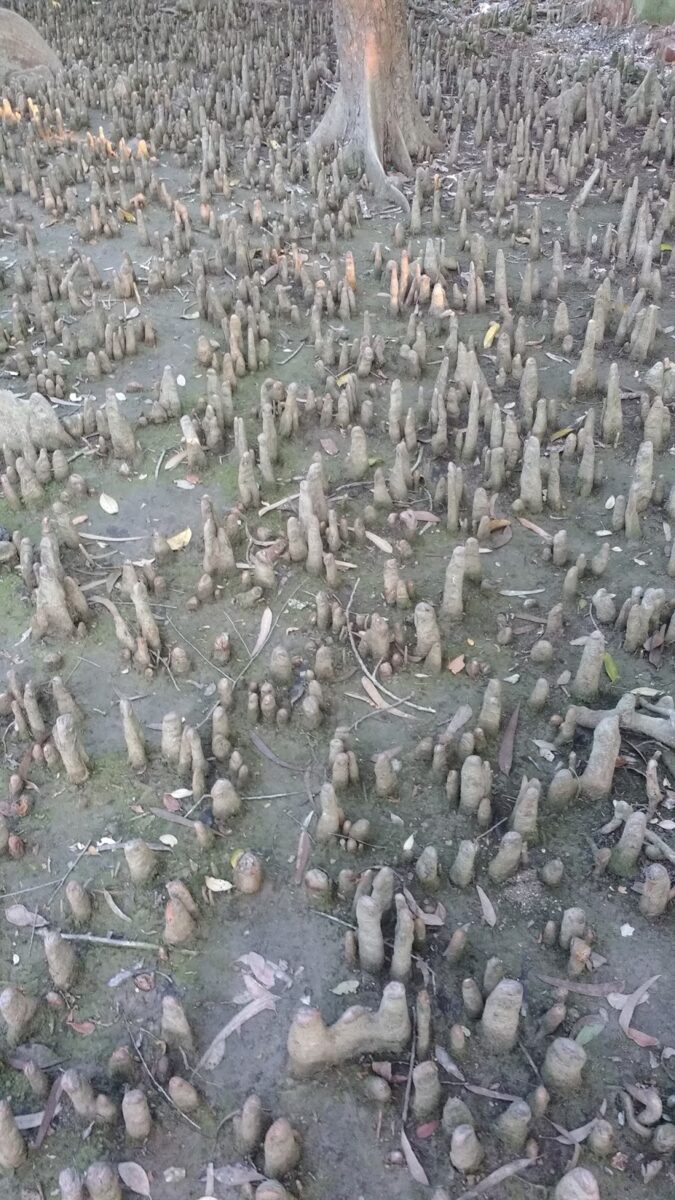
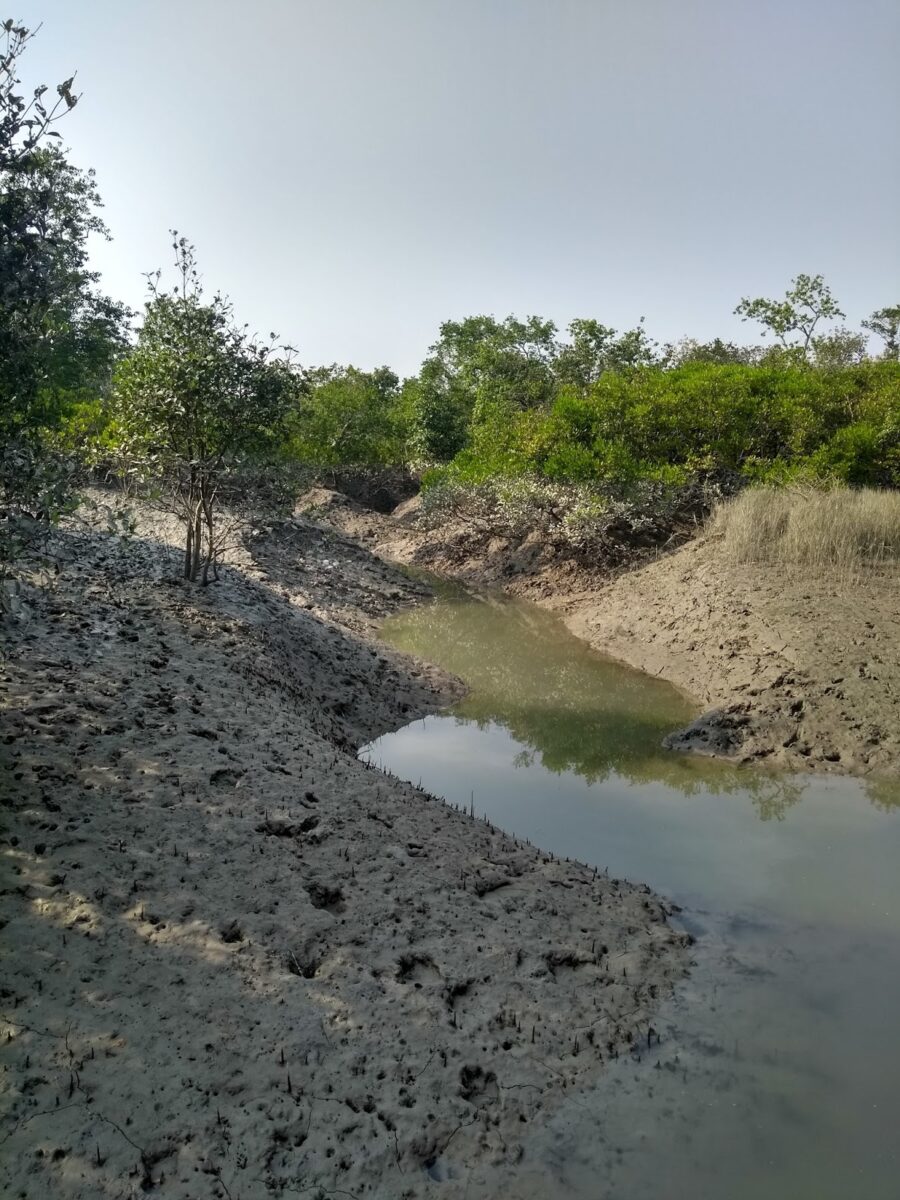
The Sundarbans archipelago comprises several islands crisscrossed by rivers and channels of sea water. The resulting saline and brackish conditions are ideal for the mangrove trees. (Rather they seem to be the only species growing there along with mangrove associates.) Elsewhere, we always explore the jungle by walking or driving through it, for example Tadoba, but walking among the trees of Sundarbans is not permitted for our safety. Which means the magnificent flora can be viewed only from the boat. While the trees are not tall, yet, in most parts, the Sun barely reaches the jungle floor. It is impossible to see beyond a few meters of the tree line along the sticky shore. The jungle floor seemed to be booby-trapped with several pointy branches poking upwards. These were the ‘breathing roots’, some of which were sharp and pointy while others were rounded. Walking through these was extremely tricky and could be painful as well, something we experienced at the Interpretation Centre. While there are dire reports of islands lost to rising sea levels, we saw some new ones that have risen up over the past decade and still rising. This was due to silt deposition.
Breathing Roots
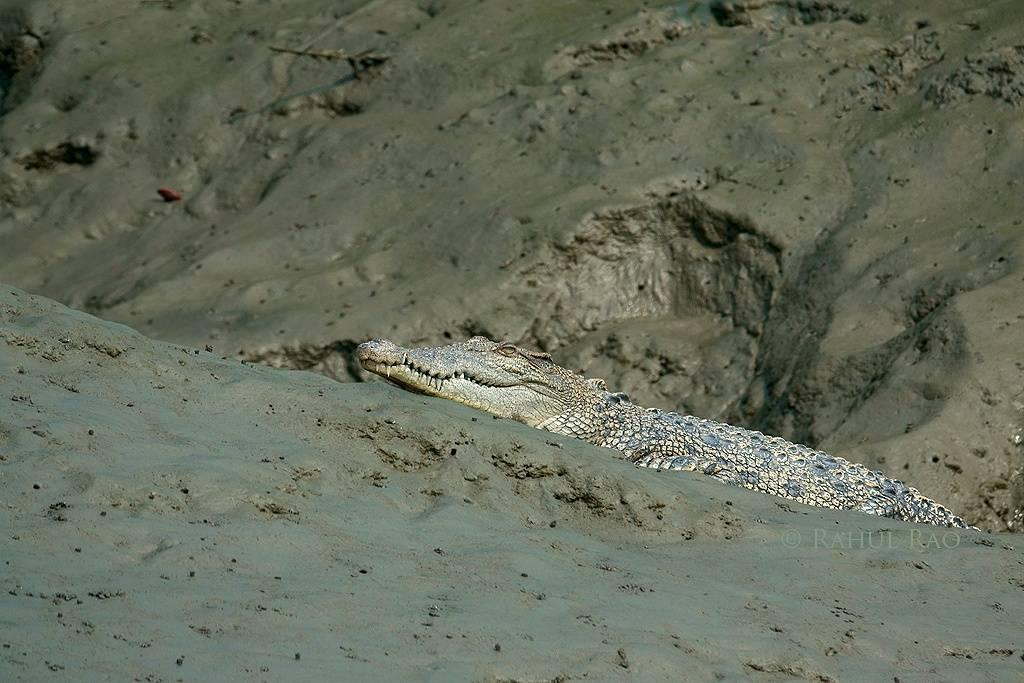
The Forest Department has created watch towers and information zones on different islands. Besides introducing visitors to this ecosystem, it is a unique way to sensitise visitors to the difficulties faced by the locals in their interaction with the jungle. Besides the tricky ground, they also face a threat from crocodiles and of course the secretive and much dreaded Royal Bengal Tiger (RBT). We did glimpse a couple of the 17 footer crocs but the RBT eluded us… I am sure we must have been spotted by one of them considering that we spent over 20 hours chugging along the coast. More about the RBT later.
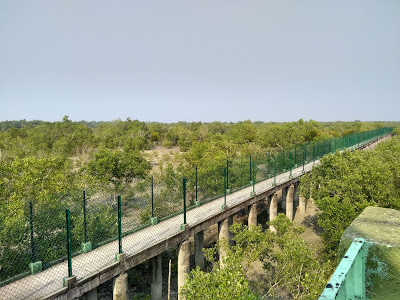
Canopy walk at the Interpretation Centre
Our resort boasted of ecofriendly credentials which meant no paper or plastic or thermacole. It offered almost all creature comforts except perhaps running hot water but I guess being environment friendly meant some sacrifices 😉 Practically it meant being served tea in the good old glass crockery (which evoked a thoroughly pampered feeling) and the tastiest of preparations made from locally grown fresh vegetables. The Nolen Gurer Payesh had us licking our lips and scraping the bottom of the bowl The efficient and ever smiling staff took pride in their work and seemed really happy.
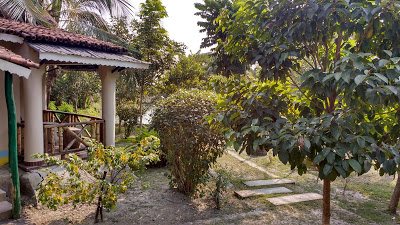
Cottages at the resort
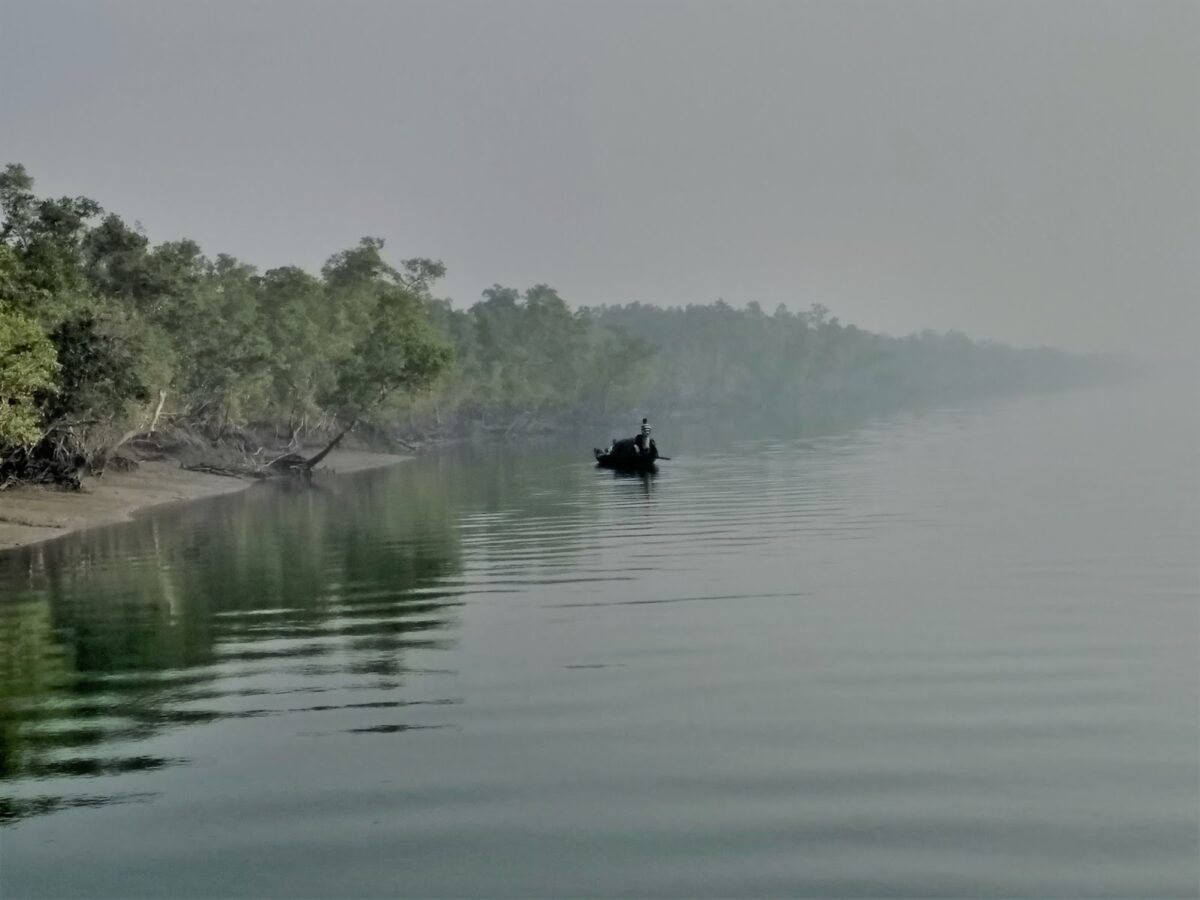
We spent two entire days on the boat. Actually three if you add up two half days as well. Our day began early at 6 am as we boarded our mist-shrouded boat – the northerly winds were the cause said Mr Paul the resort manager. We spent the entire day on board, returning only at dusk. Our guides Nabho and Krishna joined us here. Both were very knowledgeable about fauna and flora. IMHO , info about the latter is often ignored by most naturalist guides but these two were a pleasant surprise. Seeing my interest in trees, they specifically pointed out special species, their distinguishing features etc using the correct scientific terminology.
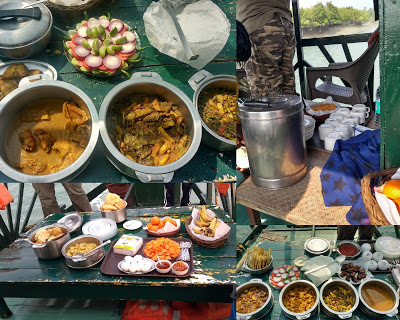
Getting back to our boat safaris… The resort staff had a detachment on the boat who had breakfast ready for us even before hunger pangs could take our minds away from the Black capped / Collared Kingfisher or many of their feathered brethren who obliged us with prolonged sightings. Now I was quite prepared for something like sandwiches but I was in for a shock. A very tasty shock I must admit. The breakfast was Alu Paratha, Puri, Omlette, Cut Fruit with the most delicious honey from the very forest we were enjoying…. Considering our location, hats off to the team! Naturally we did full justice and lunch was a bigger surprise with a choice of two nonvegetarian preparations! However the humble tomato chutney was the star – so much so that we got copy of its recipe when we said goodbye!
A spread fit for a king!
Again I digress.
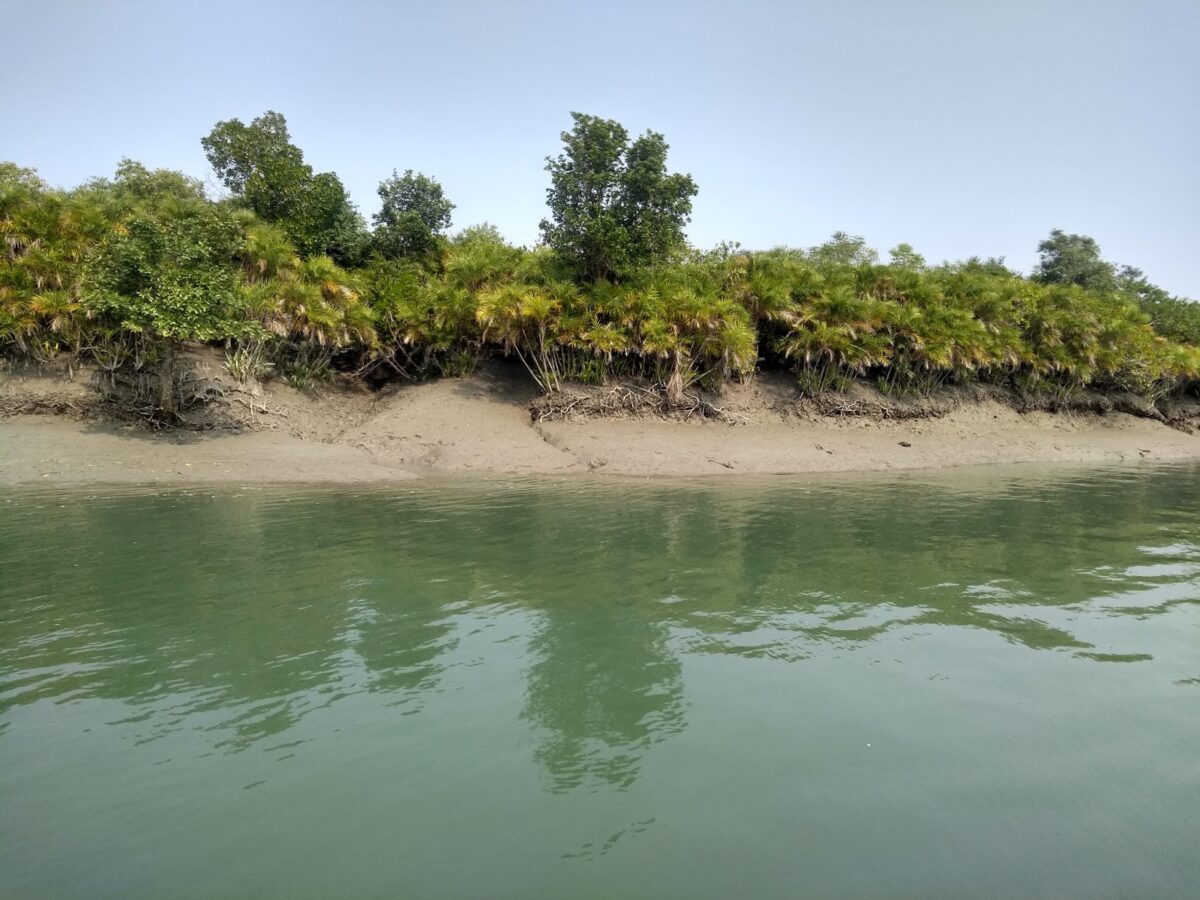
Our boat had sitting space in the front and back each with its own advantages. The best spot was to sit cross legged at the bow which gave an eye level view of the banks but I did not take advantage of it as much as I should have. Nabho and Krishna pointed out an Avicennia or Brugeira or Rhizophora but distinguishing them from a distance needed an experienced eye. Instead of their fruits or flowers it was the tree roots that were most eyecatching. As I said before, the silt laden sticky bank seemed to have become a spiky zone due to the breathing roots whereas others created an interesting circular maze at the trunk base. Some trees seemed to wear a striped skirt (formed by their stilt roots) while others had huge buttressed trunks – all aimed to give better support and improve oxygen intake from the saline water. The twice daily high tide created massive sand shifts which meant the trees needed stronger anchors than trees growing elsewhere. This is just one of the adaptation of these amazing trees. We saw some Tiger Palms and the source of their name is a no brainer – its leaf morphology and colour perfectly match with the RBT stripes making it an ideal place for the cat to hide in.
Tiger Palms growing along the bank
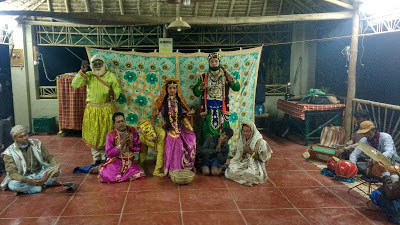
Some islands had trees with garlands and Nabho told us it was prayer and offerings to Bonbibi before someone ventured into the forest. The Goddess would protect them from tigers and other dangers. Hindus and Muslims worship her and it is faith that helps them survive in this adverse landscape as they are expected to enter the forest with ‘Khali Haat’ and ‘Pobitra Mann’. We were told that locals never utter the word Tiger because it is believed that to say its name is to call it. The danger is so real that women fast for the entire duration their husbands are out in the forest or in the boat and this can extend for many days.
A local troupe performed the legend of the Bonbibi
A bit about the RBT. This secretive cat has adapted to walking and hunting among mangrove roots and is a good swimmer. This obviously means we had a good chance of spotting the RBT both on the shore and in the water. In other jungles of our country, a water body is the ideal place to spot a tiger but in the Sundarbans, the high tide takes water deep inside the islands. The RBT has adapted to surviving on salty water which eliminated thirst as a reason to come to the water side. We could see the tiger only if it wanted to show itself to us! We passed by several small channels that went deep into the island and I am sure, we would have encountered a tiger if we had ventured into it. However that would need a smaller boat – the kind used by fisherman plus strict rules forbade us from entering inside. For various reasons, the Sundarbans tiger is known to attack humans so I guess somewhere deep inside I was secretly happy at not sighting the great cat. Even if meant seeing gleeful smiles when answering in the negative to the perennial question on our return “Did you see the tiger?”
Forbidden lanes…
We were lucky that our boat safari timing matched that of the low tide and wildlife activity. Fauna can be best seen once the bank opens up and hence hopes were high. The elusive Jungle Cat was glimpsed twice. Huge swarms of bees buzzed around our boat but flew off without a bite! Spotted Deer, Wild Boar, Monitor Lizards also found time to take a peek at us! Everytime our boat neared the sunbathing crocs, they would slip back into the water… The thought of having a powerful 17 footer croc (or even a RBT) swimming close by our basic boat ensured no one tried to dip their hands into the water….
A mammoth Estuarine Crocodile Image Credit Rahul Rao , Director at Foliage Outdoors, Pune
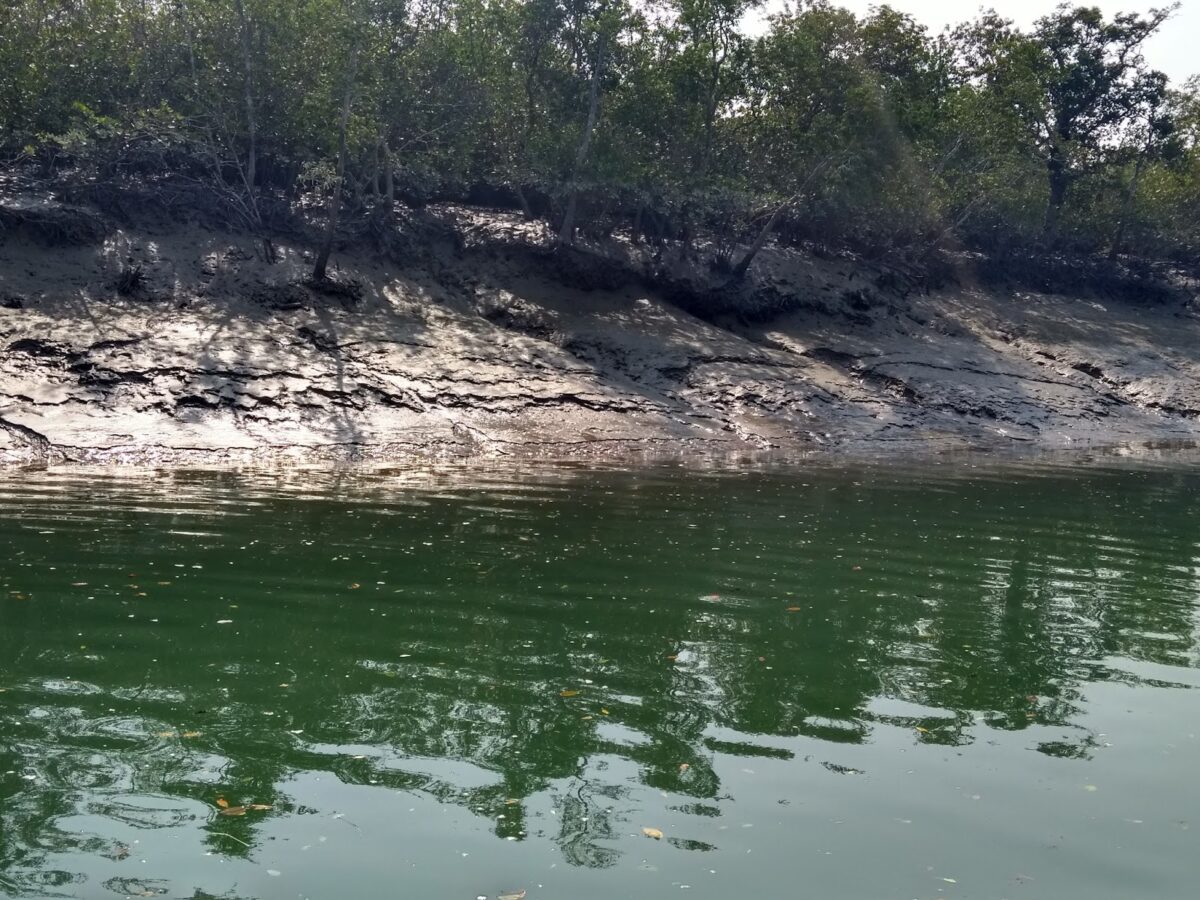
The water glittered in various shades of green with the occasional brown tinges. In the period of the low tide we sailed almost in the centre of the channels as any move towards the bank could sometimes get the boat grounded. Combined with the sand shifting we did face that situation a couple of times and recovery was by pushing the boat out with long bamboos.. Our boat did not boast of modern marine technology and the team relied on its inborn navigation skill and sixth sense. However at the day progressed and the tide came up and swallowed the banks and trees and in some cases the entire the island too. In fact, the leaves till the high tide mark were markedly different from those higher up on the tree trunk.
Our safari took us in deep waters where three or more rivers joined. This created a vast expanse of water wherein the bank was almost invisible! Though close to the Bay of Bengal, the roar of the ocean was inaudible. The tide rose and fell silently as if to let the fauna have their say. Most of the time it was just our boat MB Dakshin Rai. Its rhythmic put-put combined with the gentle sway and cool breeze under a warm sun was hypnotic and especially conducive to dozing off…. until there was a sudden frisson of excitement of spotting someone! ……
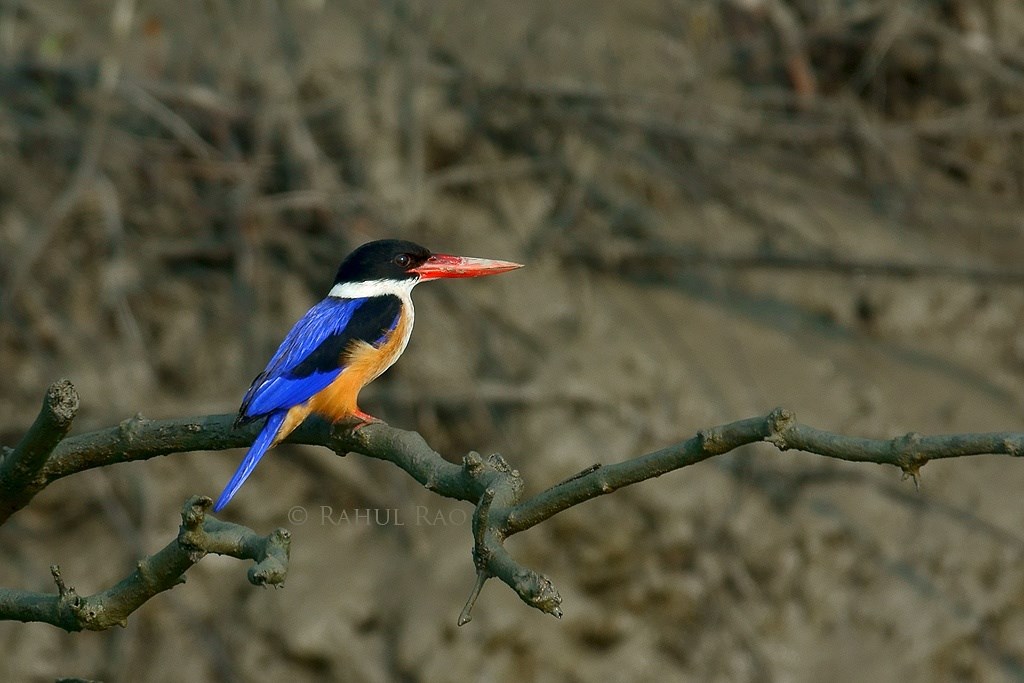
Peregrine Falcon? Croc? Dolphin? Pugmarks? Tiger? were the anxious queries as all binocs turned to one direction. Cameras clicked furiously till the object of attention decided he had enough of us! The Kingfishers including the Brown Winged were the most obliging and tourist friendly I must say!
Black Capped Kingfisher Image Credit Rahul Rao, Director at Foliage Outdoors, Pune
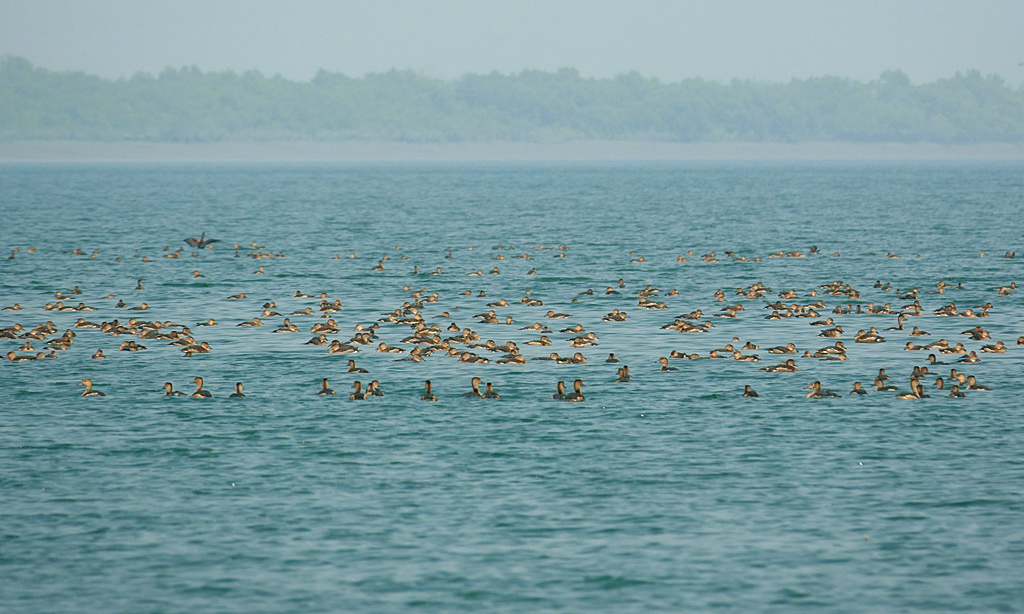
And how can I forget the Lesser Whistling Ducks who gave us a glorious farewell.. I think there must have been thousands of them along with Northern Pintails and Northern Shovellers swimming in tandem as if escorting our boat out…
Lesser Whistling Ducks Image Credit Rahul Rao, Director at Foliage Outdoors, Pune
Before I forget, most of these only live in pure environments – and their presence is a positive statement about the condition of that ecosystem.
It is a sheer joy to visit and appreciate India’s huge ecological diversity. There were no colourful flowers in Sundarbans, nor did we see the RBT nor could I walk in the forest. From all reports the jungle is a dangerous place. Yet the Sundarbans was simultaneously mysterious, attractive, enticing and chilling. Bewitching indeed!
‘…This is a land half-submerged at high tide: it is only in falling that the water gives birth to the forest, To look upon this strange parturition, midwived by the moon is the know why the name “tide country” is not just right but necessary…..’
Well, I had heard of heritage structures, heritage walks, heritage conservation and so on but a heritage tree was something unique. Come to think of it why not considering that some trees live for hundreds of years…
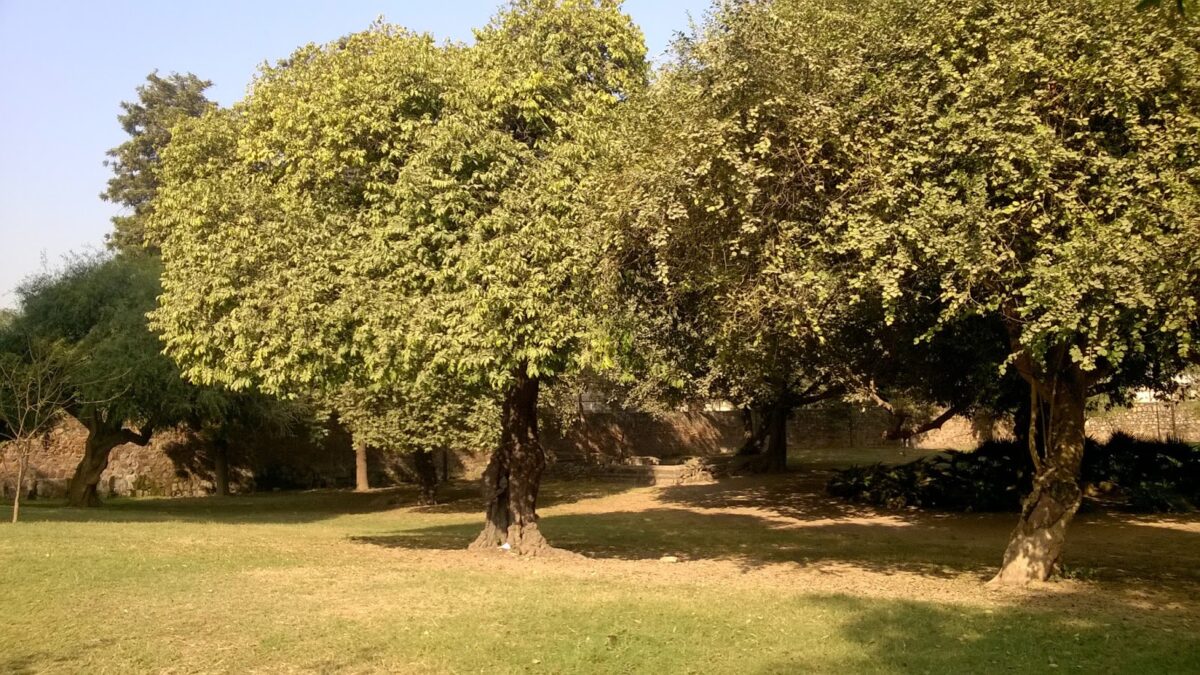
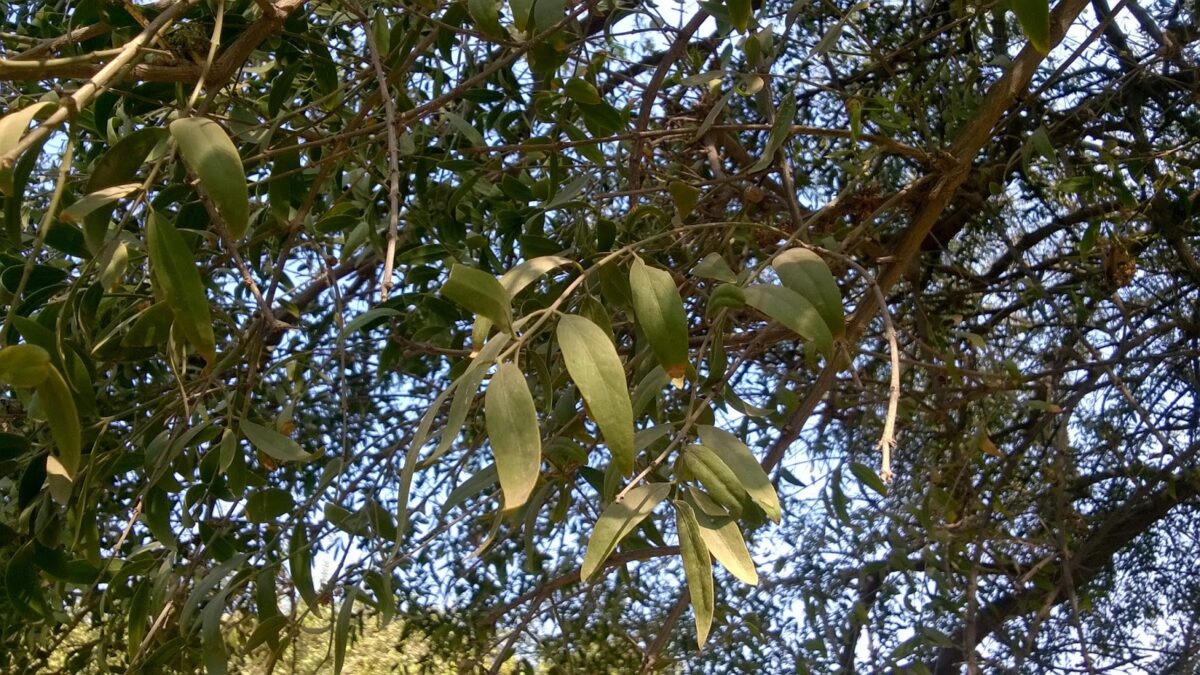
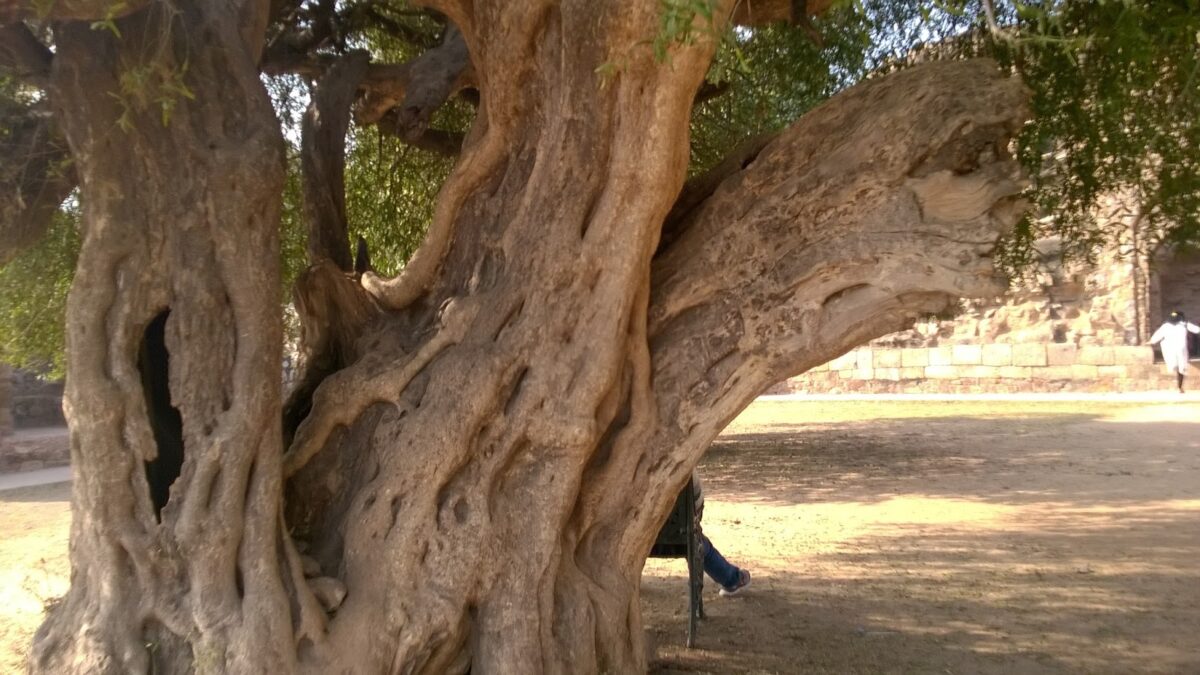
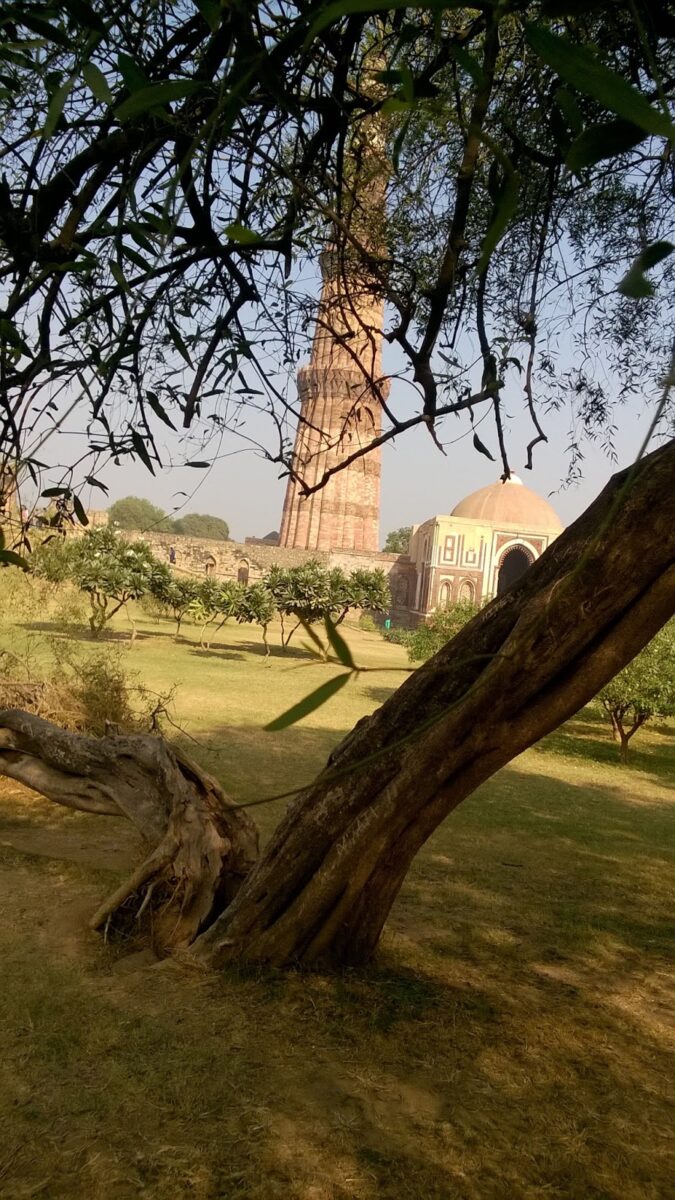
In a perfect coincidence, my tree for the day is the Pilu or Salvadora persica which I have seen in the lawns of the Qutub Minar in Delhi. Our guide told us that this tree is really really old and the tree trunk showed its age. It belongs to the Salvadoraceae family and is also called Meswak.
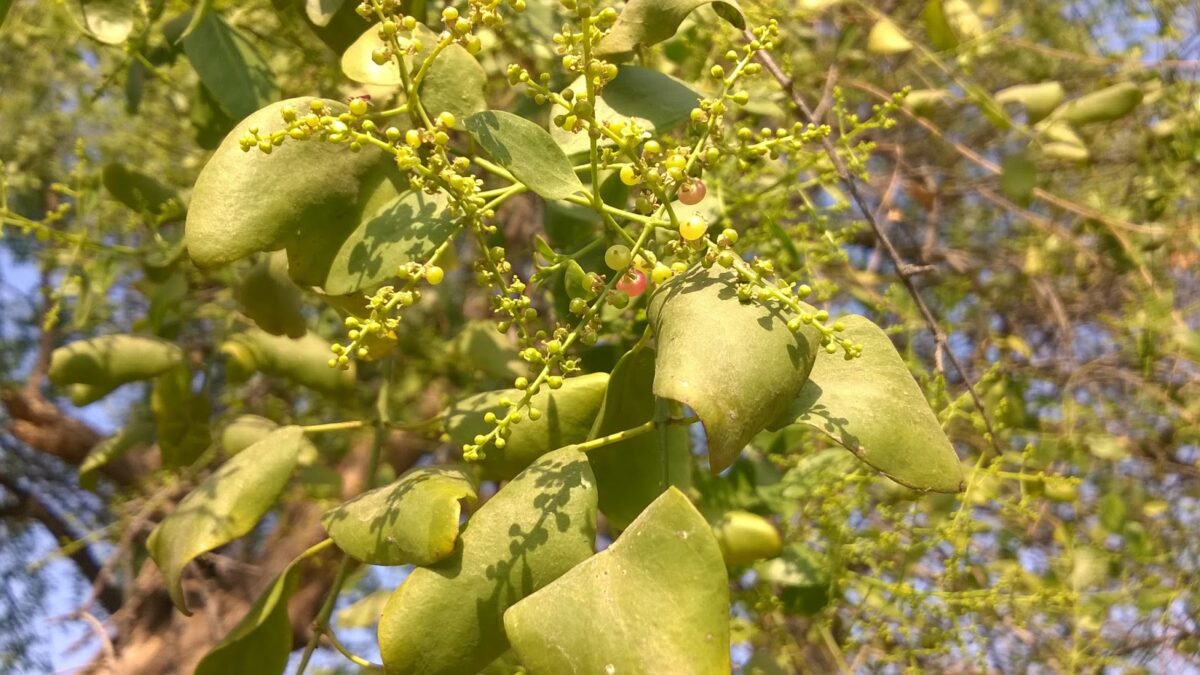
There are several of these in the complex so do take a while to spot and admire then if you do visit Qutub Minar. They have gnarled trunks with elliptic to oblong leaves with entire margins and arranged oppositely on the stems. We were lucky to see the fruits that were really beautiful glassy looking red globule like structures.
Leaves
Fruits
One of the trees has this massive trunk which has some infestation
As you can see one of the trees has fallen possibly weakened by some infection or due to weather conditions
According to my field botany teachers, this tree is a mangrove associate so how come its flourishing in dry Delhi is a bit of a surprise to me.
Have you visited Qutub Minar? Have you spotted these trees?
I am participating in Parul’s #ThursdayTreeLove27. Head over there to see some lovely trees from around the world.
And here it comes… The much awaited (I hope!) account of our maiden high altitude trek.. At first, apologies for the delay but I have finally managed to put away worldly compulsions to pen this down even as I have begun planning my next trek….
Alert: Long Post!
Feeling Dwarfed!
Our original plan was for the Kashmir Great Lakes Trek which is said to be one of the most beautiful routes in India. However the prevailing conditions in the Valley meant we had to either abandon our holiday or choose another option. That’s how we embarked on this trek to the Hampta Pass. The entire schedule was reworked and we even managed to retain part of our original reservations. The hard work put in by the excellent team at Foliage Outdoors meant we had little to worry about except staying fit!
Disclaimer: This is not a sponsored post!
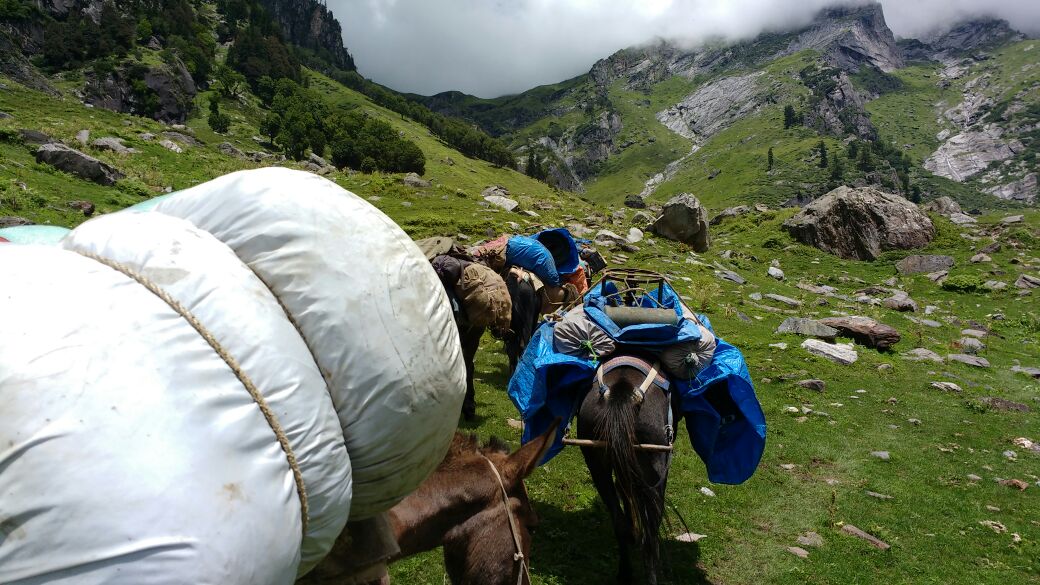
The Hampta Pass is a route taken by shepherds traversing an altitude of 14100 ft in Himachal Pradesh and begins at Manali. In retrospect, our overnight bus journey to Manali was the most boring and tiresome part of the entire trip- despite the push back reclining seats! The bus sped into the hills along the roaring Beas – its swift waters gushing over rocks and rushing to the plains. As it turned out, a river was to be our constant companion for the rest of this trip. We spent our first day at the base camp at Prinni to acclimatise, check our gear and so on. This was essential as it immediately and effectively ‘removed’ all perceived ‘urban’ conceptions about comfort! Besides our backpack which held immediate requirements, some food and water; we had packed our luggage (only 8kgs) in separate bags that would be carried by mules.
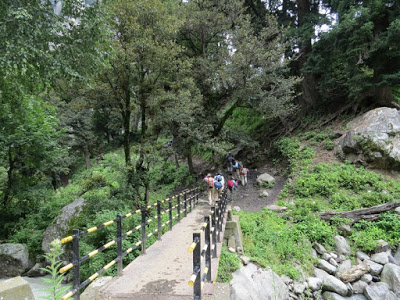
Day 1: Our trek began at Jobra and the road snaked up in a series of hairpin bends through some impressive Pines and Maples to our start point. After the issue of energy packs and a last minute briefing, we were off! The initial part took us through a thick jungle of Devdar, Oaks and Maples. Admiring these massive trees was out of question as we navigated through, over and around their roots and the slush in-between. I slowly got the hang of using the trekking pole, sipping water from the hydration pack and finding my walking rhythm. We had some veteran trekkers in our group but they did not resent having a newbie trekker like me around – patiently waiting if I took my time to reach the resting spot! A wonderful team makes all the difference to a great and happy trek experience!
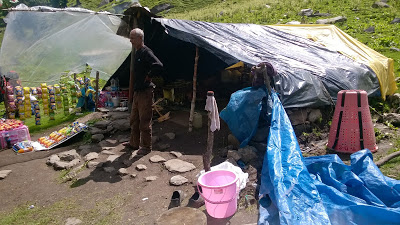
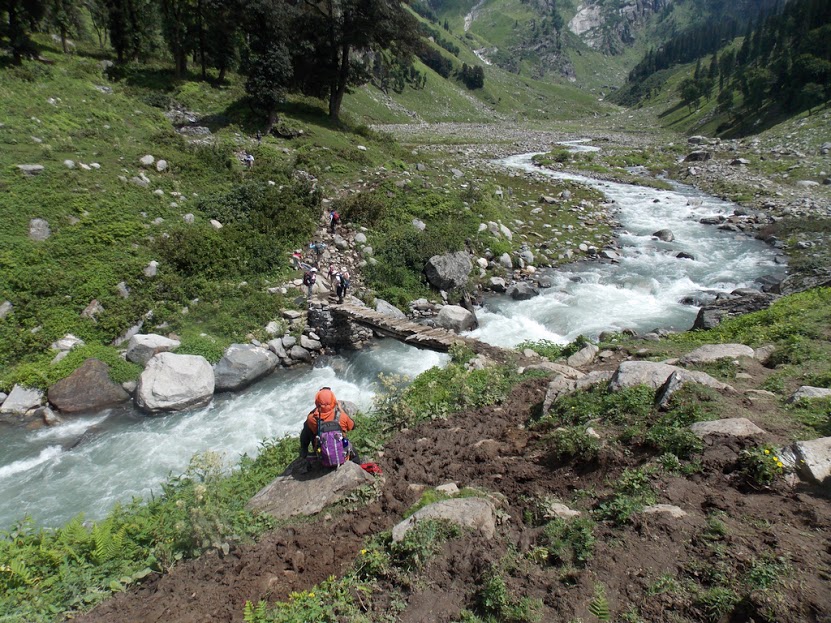
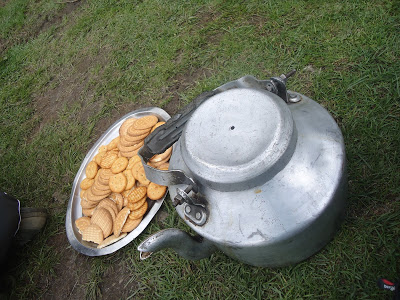
Soon the pine-needle crunching muddy track opened to a stupendous meadow that was bisected by a gushing stream. This was the Rani Nullah (I learnt later) and we accompanied it upstream for the better part of the next two days as we climbed higher and higher. A huge surprise at this spot was a makeshift ‘shop’ set up in a tent – selling tea, Maggi (yes despite all bad publicity a cup of these steaming hot noodles taste divine in the hills), Chips and so on.. Kudos to the entrepreneurial spirit of the locals!
Here we go!
A shop in the middle of nowhere!
Crossing the rickety bridge and walking in the valley! Image Credit- Foliage Outdoors
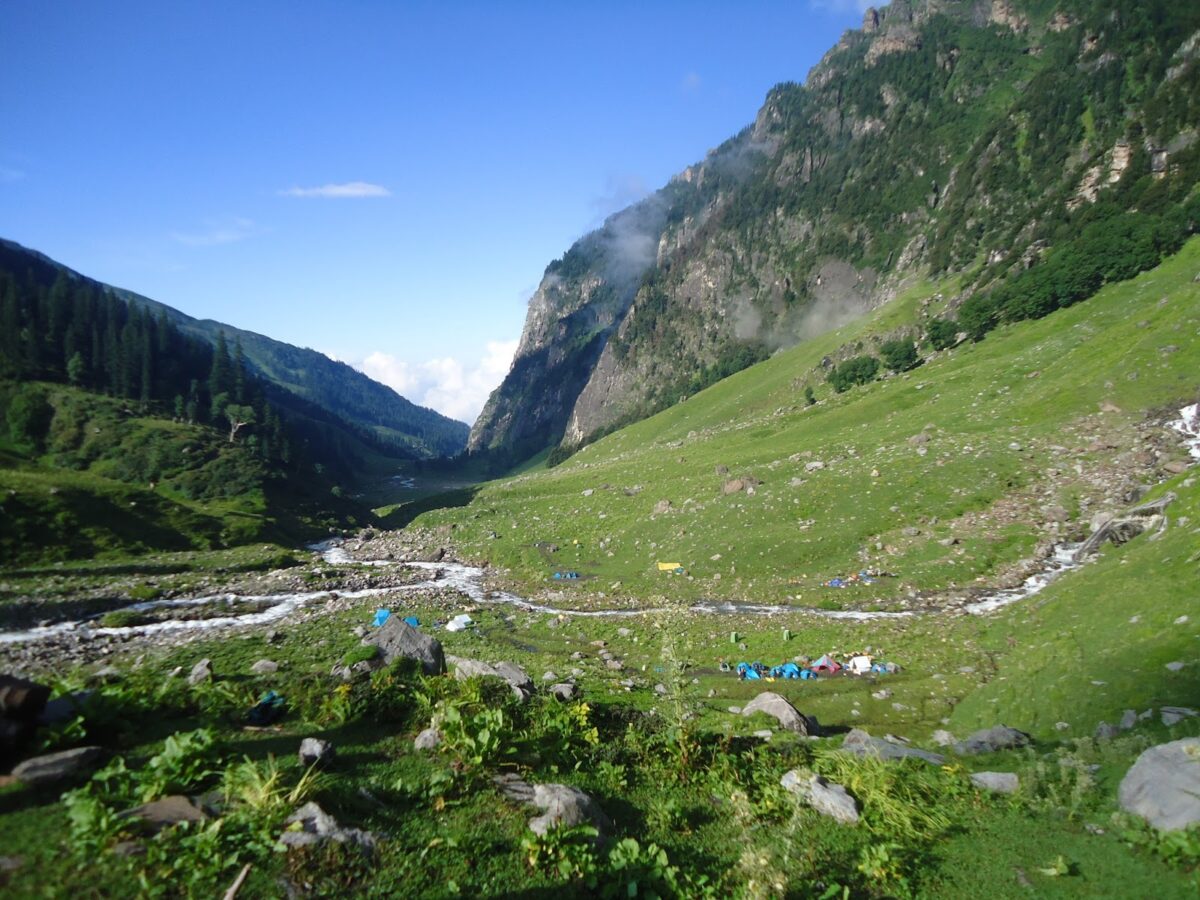
Soon we left the tree line behind as the glorious green carpet beneath us was embellished with several tiny blooms, ones that ably competed for attention with the surrounding towering mountains. The day’s work ended at our campsite at Chika (10400 ft) and as we had not done any significant climbing we were not too tired.
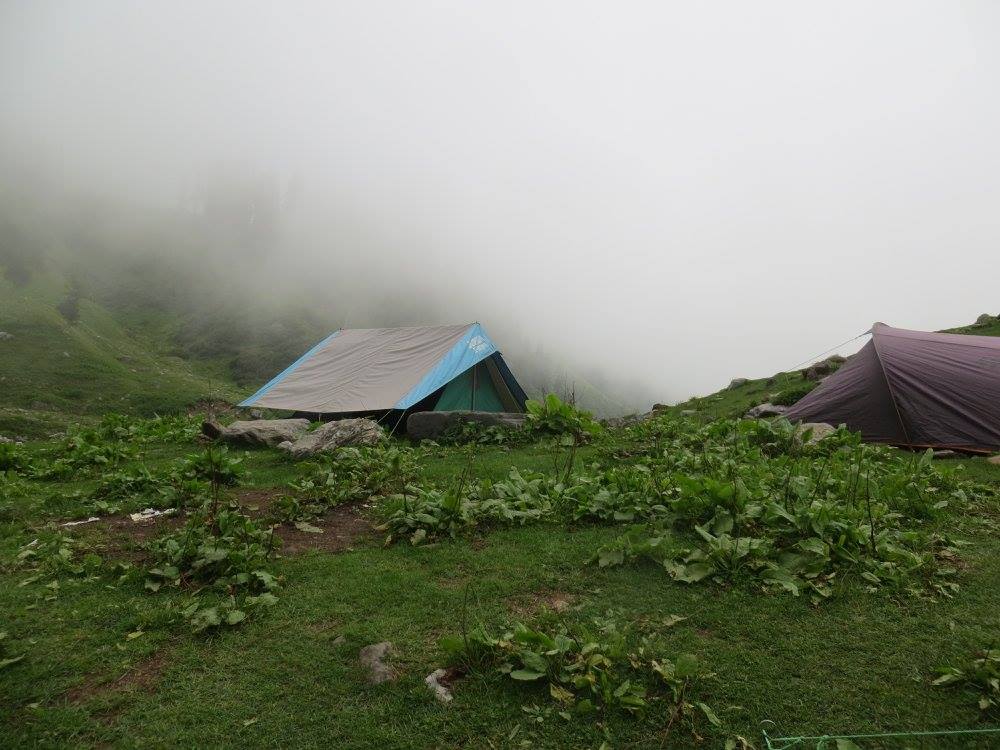
At the Chika campsite… Impending rain…
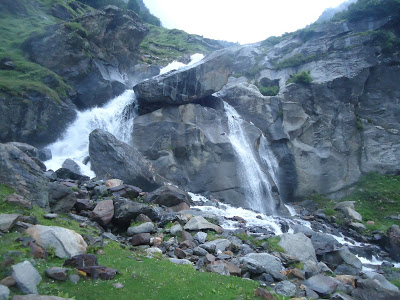
A personal waterfall in the backyard! What more could we ask for?
Our support team had hot tea and lunch waiting for us and our tents were already set up. Even as we wound down for the day, the sky looked ominous as wispy clouds descended down the mountains. Rain was imminent and after a quick dinner , we retired to our tents and tried to sleep in amid the downpour which sounded as if the all the water in the world was bearing down on us! I was worried if the puny looking tent would hold up but it did! Sometime around midnight the rain stopped and by morning a lovely blue sky invited us to start early.
The silent hardworking team members!
Leaving the campsite at start of Day 2 after a sumptuous breakfast.
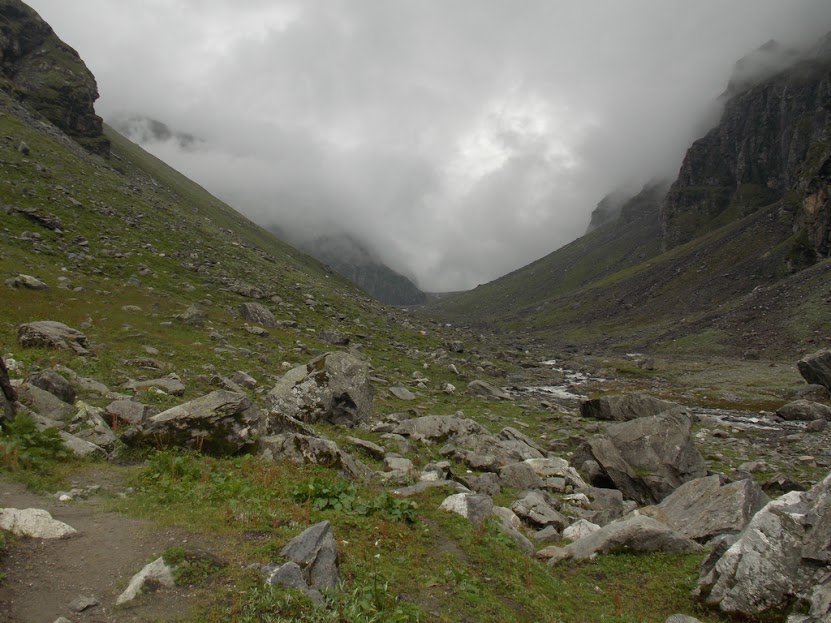
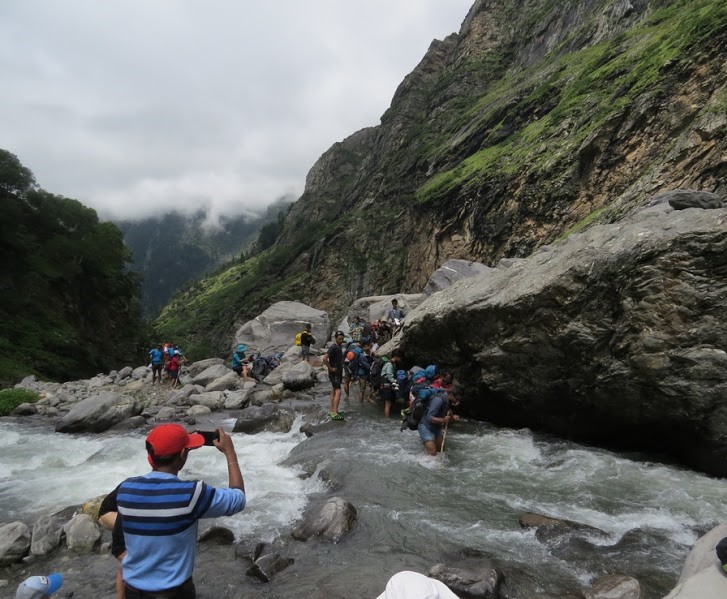
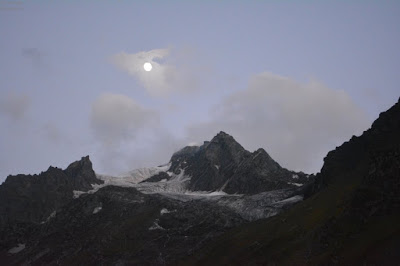
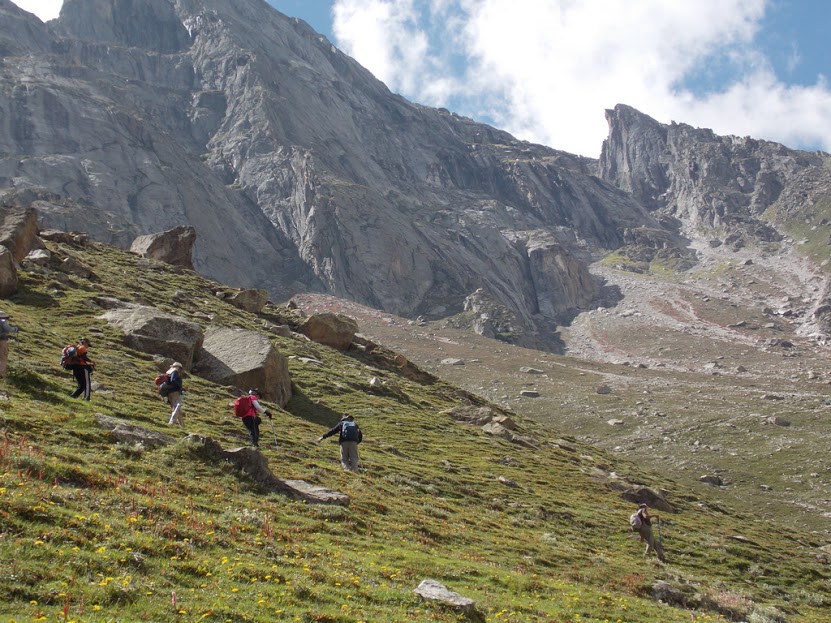
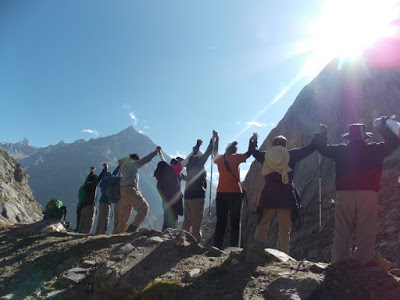
Day 2: This turned out to be a long day and the walk seemed never ending. By now we could see occasional snow capped peaks around us and soon the meadows gave way to an increasingly rocky path. Moraine is the correct term I believe. There were endless little streams to cross but one particular one needs special mention. Its rapidly-flowing knee-deep water demanded special methods to cross. We removed our footwear and socks made a human chain to wade across. Our feet and legs were totally numb as we emerged on the other side. Luckily no one slipped as one fall would have meant all of falling into the freezing water or worse — getting swept off. At another place, we walked under a water fall! I eagerly looked forward to the rest halts even as our progress was slowed by some rain en route. The camp site at Balu Ka Gera at 11900ft was next to the silently flowing stream. It was a full moon night but rain sent us scurrying into the relative safety of our tents.
The campsite seemed simply too far away as we encountered moraine.Image Credit- Foliage Outdoors
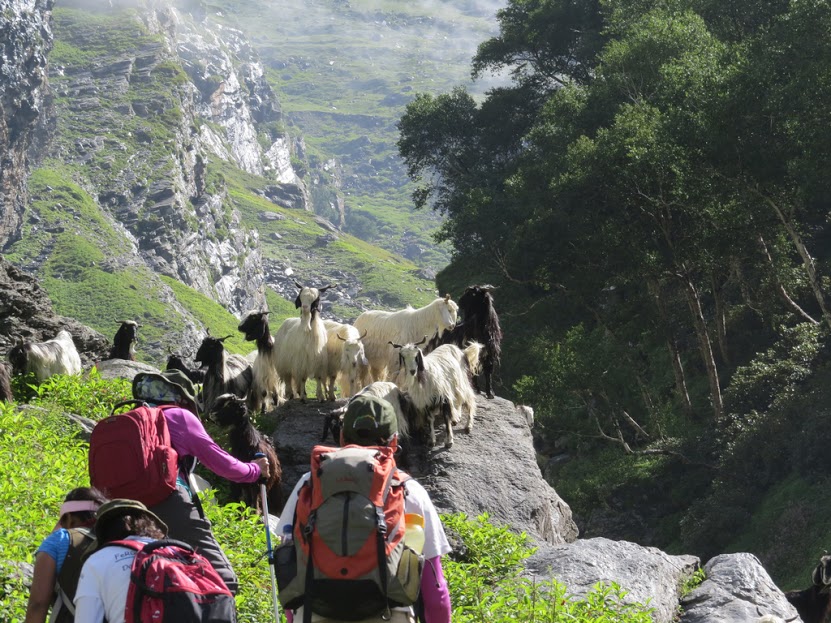
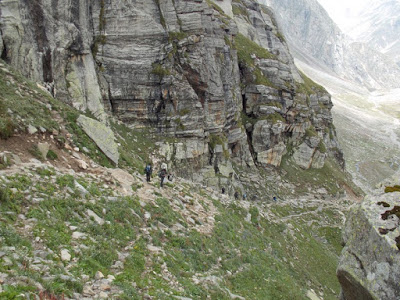
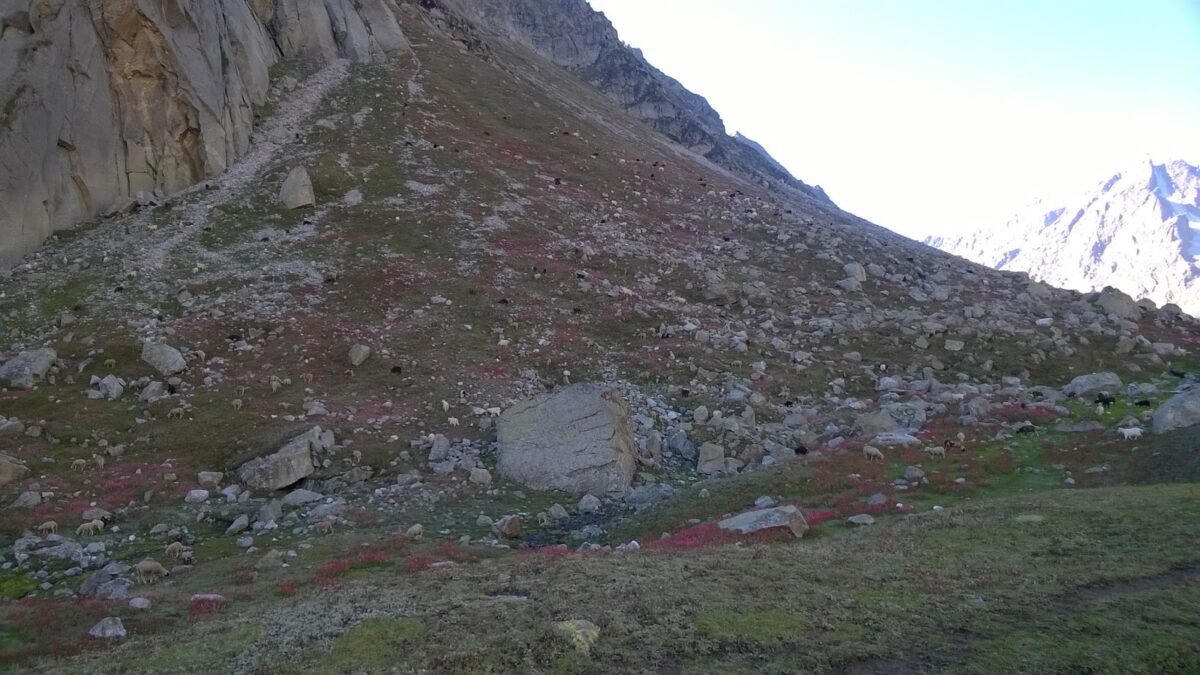
Negotiating our way over rocks and through flocks of mountain goats! Obviously the traditional lifestyle still continues in this part of the mountains…
Looking back at fellow trekkers making a human chain to cross this stream Image Credit- Foliage Outdoors
The clouds rewarded our day’s effort by moving aside to give us this stupendous view! Image Credit – Ashwini (our fellow trekker)
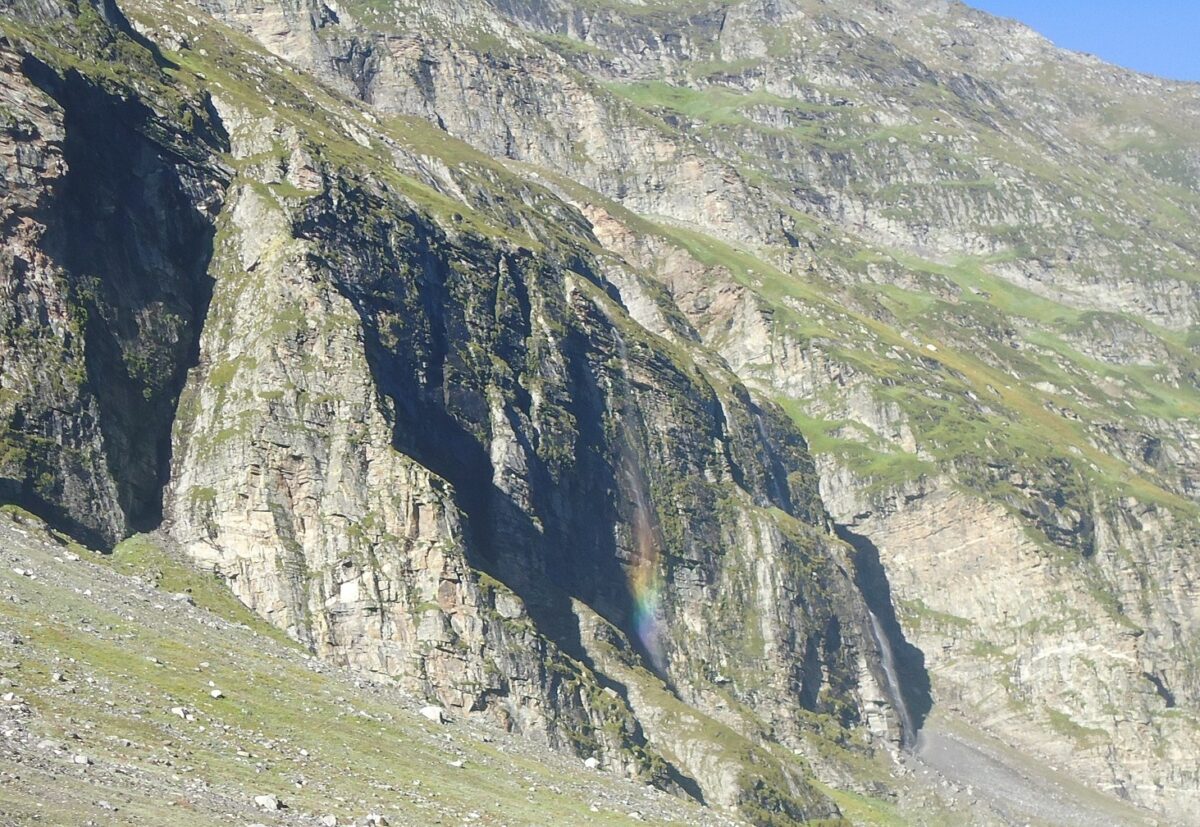
Day 3: Its on this trip that I truly appreciated the restorative powers of sleep! Six hours of dreamless slumber in a Sleeping Bag laid out on rocky ground protected from roaming sheep dogs and pouring rain by two layers of a fabric tent had me raring to go the next morning. Its was the day for us to summit and cross the Hampta Pass. Our leader cautioned us about the long journey ahead and to watch out for Mountain Sickness. A glittering rainbow on a waterfall bade us farewell from Balu Ka Gera..
Let these photos speak for themselves…
Day 3 begins with this rainbow in the waterfall!
A glacier-view tent at Balu Ka Gera
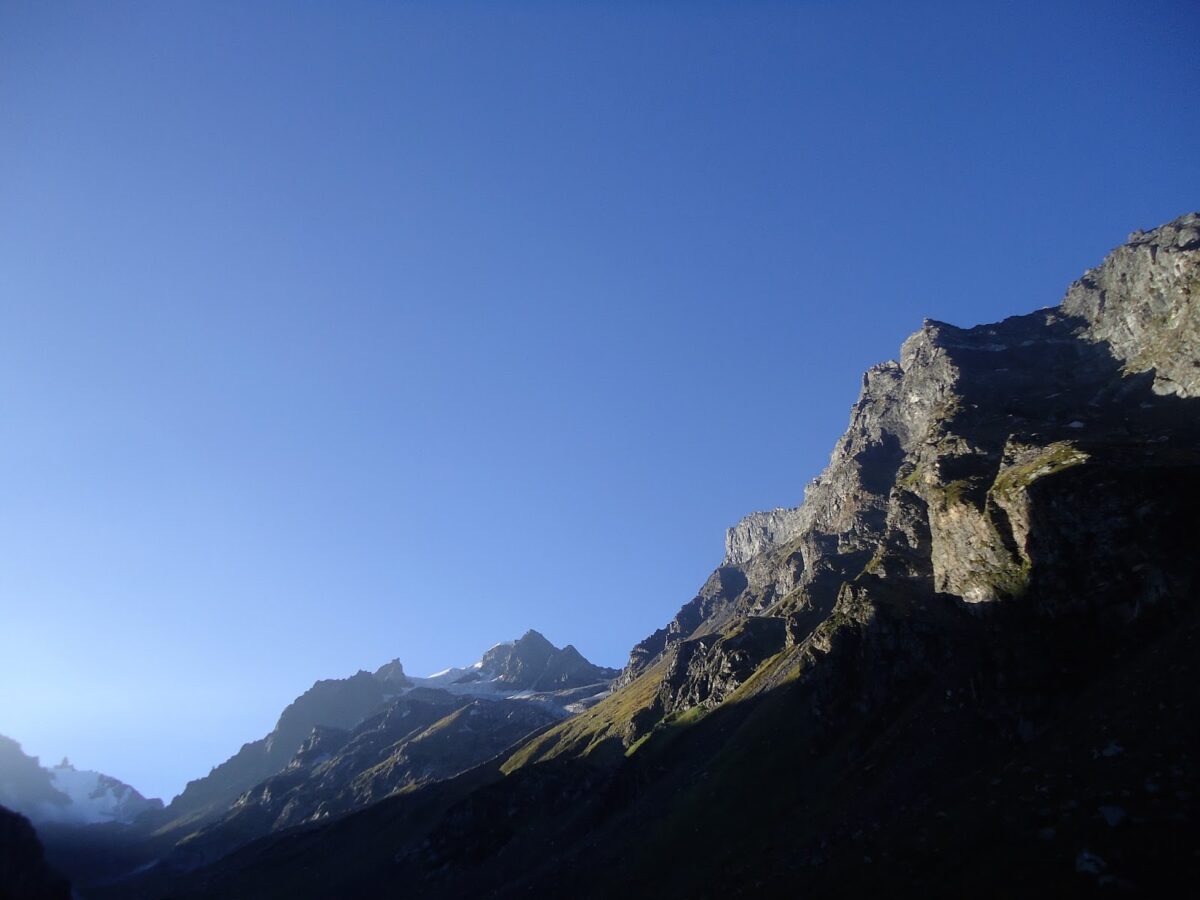
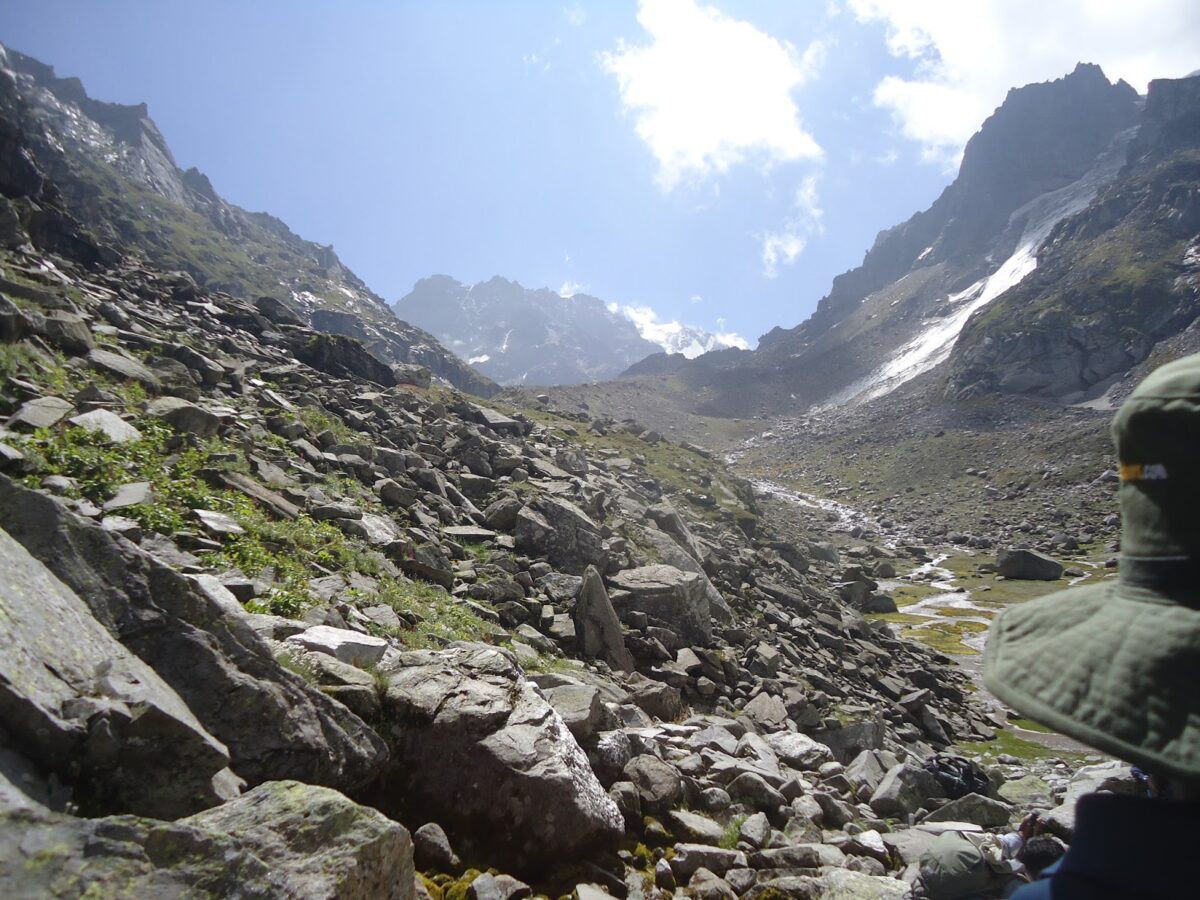
A long long way to go…
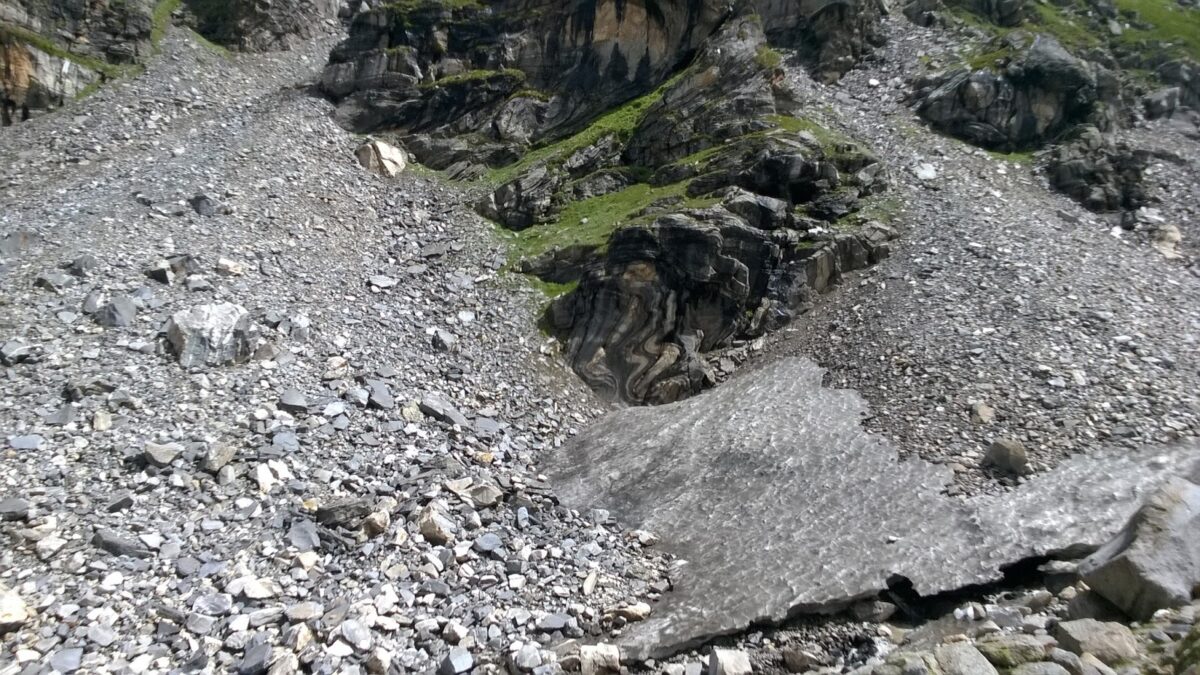
Melting glaciers created interesting patterns on rocks.
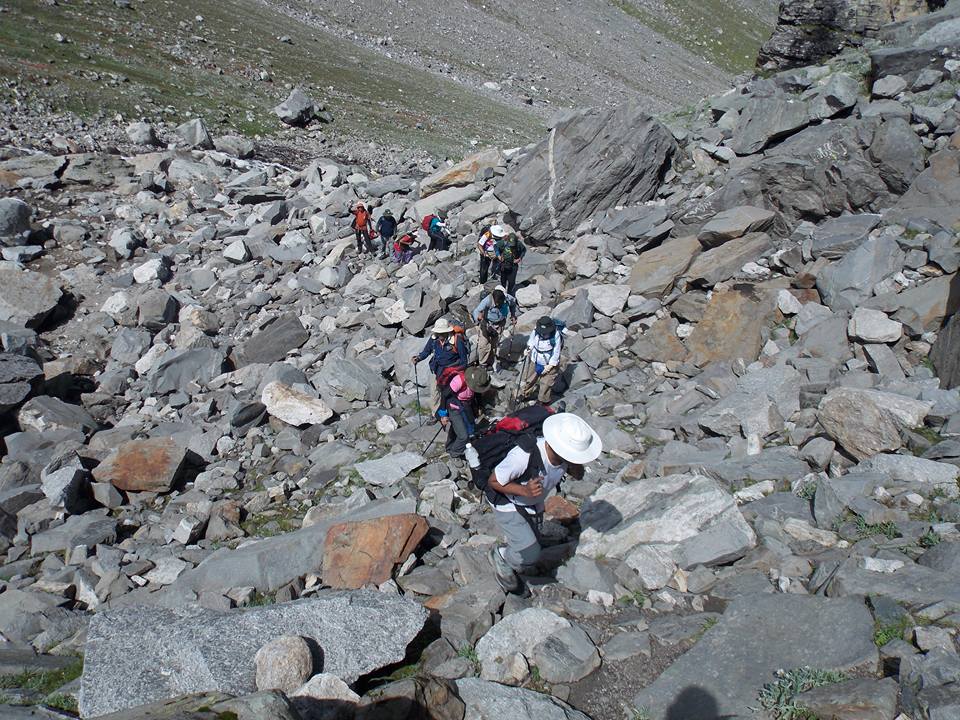
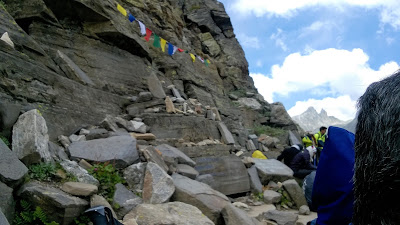
Almost there! The last stretch was challenging. Notice the huge boulders that we climbed!
The Hampta Pass! Catch your breath and get set for the steep descent. Admire the glaciers as well as the Indrasen and other surrounding Peaks that look down upon us!
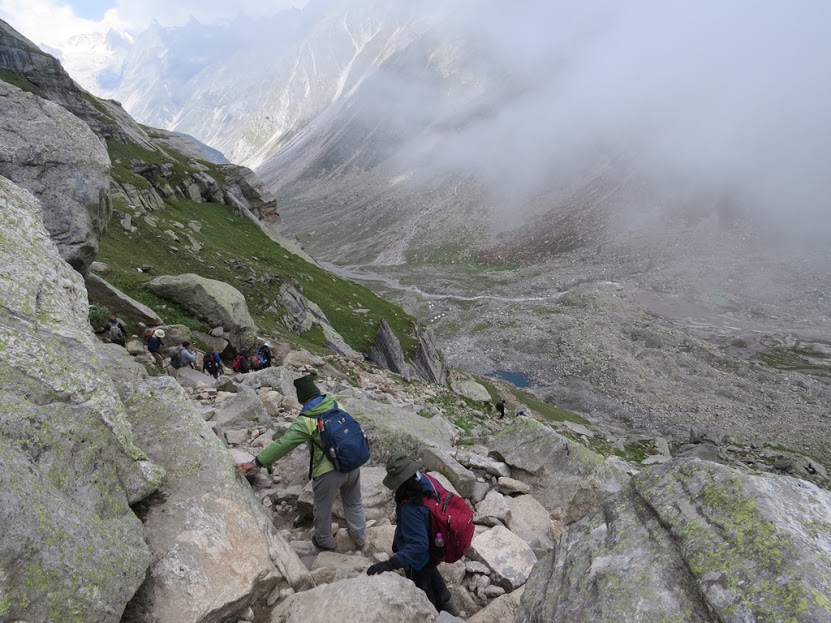
We climbed down to the tiny white tents.. Can you spot them?? Notice the green lichens on the rocks. Image Credit Foliage Outdoors
The descent puts intense stress on the knees as I learnt the hard way. I had carried many kinds of first-aid but no knee caps. This made me the laggard of the group for the rest of the trip… Image Credit – Foliage Outdoors
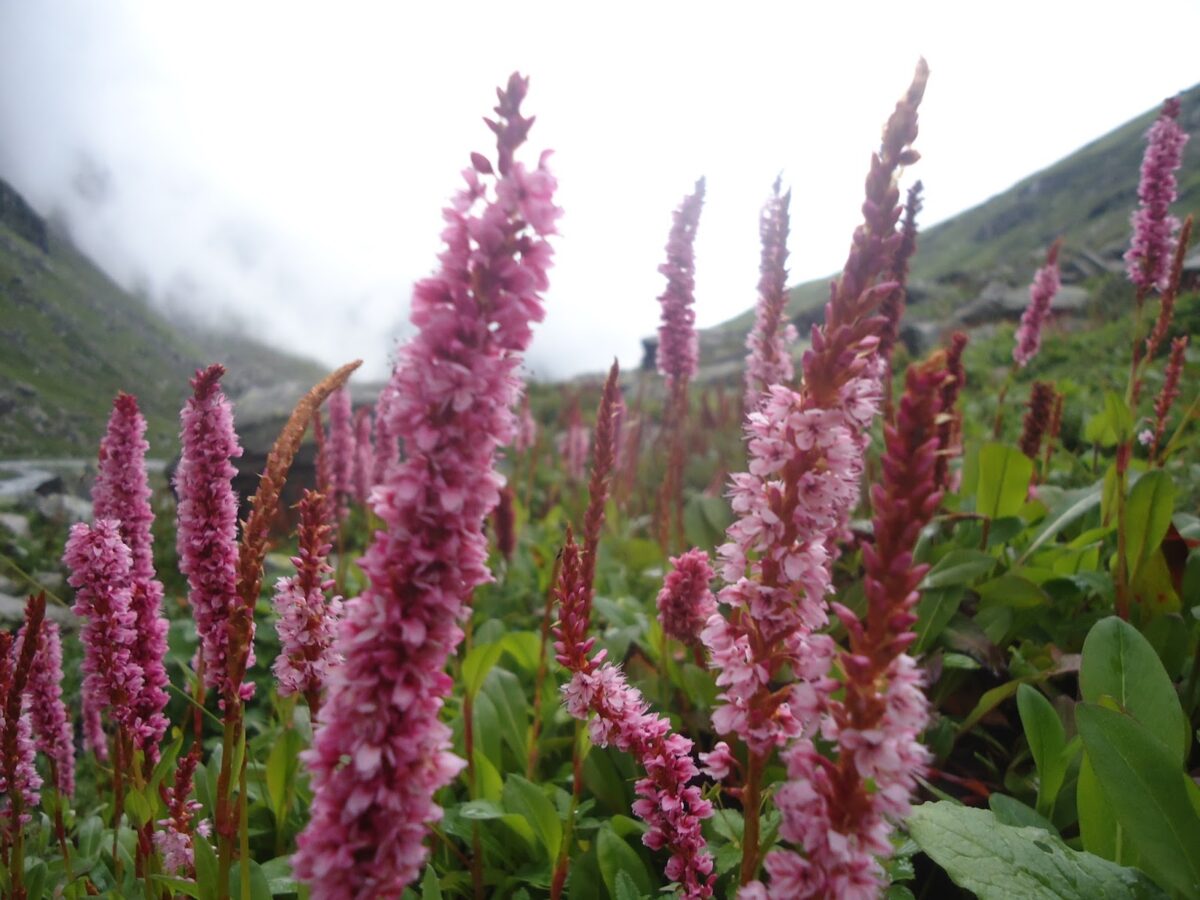
The Himalayan Fleeceflower (Polygonum affine) painted the mountains at the Shea Goru campsite to wonderful shades of pink offsetting the green lichens on the rock.
A hot cup of tea was waiting for us at the end of a really long day of walking. A chilly wind blew from the glacier down to the campsite ensuring I wsa bundled up in a cap, gloves and five layers! This region is called a cold desert…
Day 4:
This was supposed to be a relatively easier descent in comparison with the previous day! And it was. The glorious views and the painted mountains meant this day’s views were possible the most beautiful … But that would be unfair… Each day had brought forth a special and unique aspect of Nature… The day began by a very tricky river crossing on a pair of logs and holding on to a rope. The trick was not to look down and focus on one point. By God’s Grace, we all make it across safely and reached the Chatru camp in good time.
With reducing elevation, grass made a reappearance
End of the walking phase of the trip!
From Chatru we drove to Chandratal Lake but I shall reserve that for another post. This has become quite long and Thank You dear readers for patiently reaching this point….
Its been very difficult to choose images today, one of the reasons for the delay in posting I suppose. None of them really do justice to Nature’s beauty. The Himalayas are imposing, dominating, craggy and moody still manage to mesmerise everyone. I am in the process of planning by 2017 holidays and the Hills are calling!